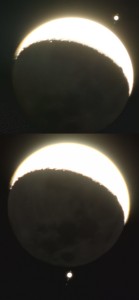
I don't know anything about astrophotography and as my scope is a non tracking dob, I haven't given much thought to it. However, I saw the article in PC Mag. and was wondering if this new sensor would make astrophotography w/o tracking possible?
From PC Mag.
"Planet82 is demonstrating its new Single Carrier Modulation Photo Detector (SMPD) for the first time in the U.S. The company says the sensor is 1000 times more sensitive to light than traditional photo sensors—it can take picture in near total darkness. Planet82 says the sensor can capture images when light level is less than 1 lux (or up to 0.1 lux). One lux is the same brightness from one candle one meter away in a dark room. Human eyes can barely distinguish images at less than 1 lux.
Planet 82's Single Carrier Modulation Photo Detector
The sensor Planet82 uses what the company calls "principles of quantum mechanics to produce thousands of electrons out of one photon." The company also minimized the aperture ratio and increases the number of pixels per unit density on the chip. The sensor is manufactured using a CMOS process and is half the size of current CCD sensors.
Planet82 expects the SMPD image sensor to be available in CCTVs, digital cameras, video cameras, camera phones and vehicle parking sensors beginning in the first quarter of 2006."
