I don't past very many images on this forum because most of my efforts would suffer so badly from comparison.  This one, though, felt like it was appropriate.
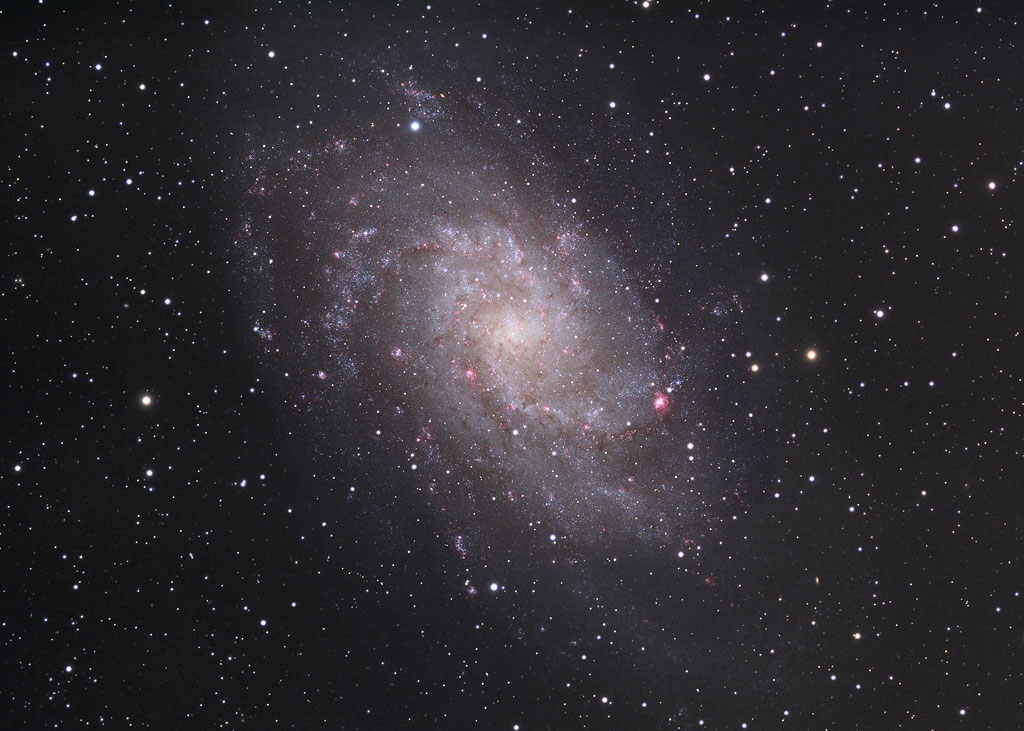
M33 captured from Mill Valley, CA on the night of 9/27-9/28
Astro-Physics Mach1 mount; SBIG STL-11000 camera; APM/TMB-152 @ f/8
Captured in Equinox Image; Calibrated in Maxim DL (flats, bias, and hot pixel map); Deconvolution in Maxim DL layered in Photoshop CS3; Color combine, curves, levels, and noise reduction in Photoshop CS3
70 minutes luminosity; 60 minutes H-alpha (merged into the red channel); 30 minutes each RG&B
I took the H-alpha while the moon was still up, and the rest of the data once it became dark. Strangely, I realized this is the longest exposure I have ever done (even though it's only a little over three and a half hours). Got to find a way to get out more and capture data over multiple observing sessions!
- Jared Willson
This one, though, felt like it was appropriate.M33 captured from Mill Valley, CA on the night of 9/27-9/28
Astro-Physics Mach1 mount; SBIG STL-11000 camera; APM/TMB-152 @ f/8
Captured in Equinox Image; Calibrated in Maxim DL (flats, bias, and hot pixel map); Deconvolution in Maxim DL layered in Photoshop CS3; Color combine, curves, levels, and noise reduction in Photoshop CS3
70 minutes luminosity; 60 minutes H-alpha (merged into the red channel); 30 minutes each RG&B
I took the H-alpha while the moon was still up, and the rest of the data once it became dark. Strangely, I realized this is the longest exposure I have ever done (even though it's only a little over three and a half hours). Got to find a way to get out more and capture data over multiple observing sessions!
- Jared Willson
Attached Image:


