Image of the day

Captured by
Michael Scherman

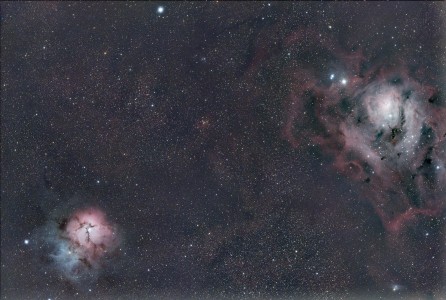
Lagoon and Triffid Celestron C6 Hyperstar4

My Account

New to Astromart?

Register an account...

Need Help?

What is your favorite EP for galaxy details?

Started by Mta472, 11/10/2006 02:59AM
Posted 11/10/2006 02:59AM Opening Post
I have a 12 inch Meade LX90 and would like to get a consensus of opinions on what is your favorite/best eyepiece for viewing details in galaxies?
What type of EP - eg orthoscopic, Plossl, orthocentric?
What focal length?
Even what brand do you find the best?

Enjoy the day.......Mike
Posted 11/10/2006 12:54PM #1
Well, the Tele Vue type 4 and type 6 Naglers are excellent in my book. Depending upon your magnification preference, either a 17mm T4 or 13mm T6 would be a good choice. The old Meade 14.4mm UWA is also a very fine deep-sky ocular. With a slow f/10 telescope, there are many other wide-field designs such as Koenigs and so on that will work quite well, but with less apparent field of view than the Naglers and UWAs.

Some people prefer orthos for DSO use. I generally don't see much fine detail in galaxies to begin with so I prefer the larger AFOV of the Naglers and eyepieces like the Pentax XW line.

Did you mean monocentric? I don't think that a monocentric, with its very small AFOV and other issues, is considered a good choice for this purpose.

Dave Mitsky

Chance favors the prepared mind.

De gustibus non est disputandum.
Posted 11/10/2006 09:32PM #2
An acquaintance of mine routinely uses 300x and more for faint galaxy groups, with a 20" dob. His main eyepiece for this is the 7mm Type 1 Nagler, that can be found on Astromart for reasonable prices used.

Myself, I don't have as much experience. But I am tending to use >100x much more often than I used to for finding details. My current main eyepieces (subject to change of course) are 20T2 Nagler (100x, 4.0mm exit pupil), 13T1 Nagler (150x, 2.6mm exit pupil), and 9T1 Nagler (220x, 1.8mm exit pupil) (16" f/4.9 dob)

The wide field helps in locating and hand-tracking.

I have a 9mm UO ortho that is a bit sharper than the 9T1 but loses big on FOV. The ortho is not used nearly as much.

Mike
Posted 11/10/2006 11:41PM #3
Naglers. In my 16" f/5 I generally prefer the 11mm T6 for fainter galaxies--I just seem to get the optimum contrast in a 2 mm exit pupil--but for brighter galaxies I sometimes prefer the 16mm T5. For example, the 16mm gave me the better view of the spiral arms of M81 a while back. The sharp wide field of both really helps in finding the fainter objects, as well as increasing the pleasure of the view.
--George

George Golitzin
Posted 11/12/2006 02:31AM #4
Since you asked about galaxy details, not wide field, I'd have to say orthoscopics. In trying to finish the whole list of Herschels, I've become somewhat of a galaxy specialist and I use orthos when seriously observing.
Posted 11/13/2006 07:21AM #5
Mike,

Since galaxies come in all kinds of sizes and shapes, I think it is not possible to give a generally valid answer to your question.

I use low magnification for galaxies like M31 and M33. My telescope has more or less the same aperture as yours but the focal length is different. A 24mm Panoptic gives 63x with my scope, and this is ok with M31. For M33 I generally see more with my 13mm Nagler (115x). I use magnifications in the same range for large, phantom galaxies with low surface brightness, and if I want to view groups of galaxies (M84/M86 with neighbours, NGC3190 group, M81/M82 etc.)

I enjoy looking for detail in spiral galaxies, and in most cases I find it necessary to use higher magnification in such cases. For M101 I use 115x since it is so large. Its spiral features are subtle, but under dark, clear skies it appears as the most beautiful of the spirals in my telescope.

M51 is easier. For most detail I use a 9mm Nagler (167x). Possibly I would even go up to 214x (7mm eyepiece) if I had one in my collection. With my present experience a magnification of 150 - 250x is best for smaller spiral galaxies with a 12-inch. Among the easier spirals are M99 and M61. They are quite small, and you are likely to miss the spiral structure if you use too low magnification. M83 is larger, and almost as easy as M51. M100 is a hard nut for a 12-inch. According to some observing guides it is doable, though.

I also find the 150 - 250x magnification range to detect dust clouds in objects like M82, NGC3556, M64, NGC4565 and NGC891.

I presently own a pure TeleVue line of eyepieces. However, I also have good experience with UO Orthos. On one special occasion I also tried a narrow field Monocentric eyepiece. The view of M82 through this one (I think it was with a magnification around 170x) was unforgettable. The amount of bright sky background was cut down to a minimum, and therefore the galaxy appeared brighter than through a wide field eyepiece.

My conclusion is that the eyepiece design or brand is of less importance than the magnification (or exit pupil). The rule from old times of always using the lowest possible magnification does not apply any more. Much of the joy of observing is to have the option to make some trial and error. Different magnifications and fields of view give different impressions of almost any object.

Inge S
