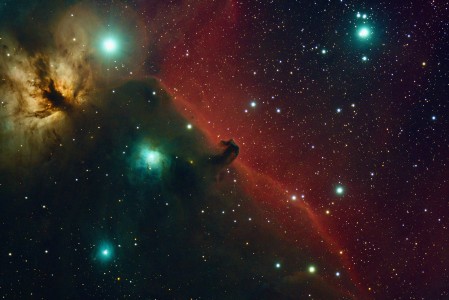
Image of the day

Captured by
Erwin Forbragd

Horsehead Nebula

My Account

New to Astromart?

Register an account...

Need Help?

Top 5 objects to observe right now?

Started by toml, 12/16/2002 04:27PM
Posted 12/16/2002 04:27PM Opening Post
Surely M42, Pleiades, Saturn and Jupiter, but as I'm new, I find it hard to tear myself away from any of those 4 things long enough to go hunting for other caldwells or messiers.

But may I ask, which of the other Cs or Ms would really be worth my limitted light polluted observing time to tear myself away from the main attractions above?

What are the best 5 'other' targets and I will try to focus on those for a change...provided the great Pacific Northwest Nebula blows away soon smile

TomL
Posted 12/16/2002 05:39PM #1
You've got to take a look at M37 Auriga. You can find it with binoculars but you need high power on this to bring up the faint stars that cannot be seen with low to moderate power. Try 125x to 150x.

M35 Gemini at a lower power maybe 50x to try and spot 2158 very nearby to the south west. M35 is bright and easy, 2158 is small, faint and difficult. 2158 is more difficult at higher powers.

Late night or early morning M46 in Puppis. Close by is M47, a group of bright scattered stars. but M46 is kind of like M37, very densely populated with very many faint stars. And M46 also has an embedded planetary nebula. You find it with low powers maybe 30x or 40x, but then you need high powers to bring out the very faint stars.

The galxay pair M81/M82 in Ursa Major. You need maybe a 45' fov to see both at once, but higher power brings out more detail in each one seperately. You can easily bump up the power and turn back and forth between the two because they are lined up nearly N-S. There are two other faint galxies and a few very faint close double stars just off the southern edge of this pair. You need to look closely to see the doubles.

The double cluster 869-884 in Perseus will blow you away. Low power will show both together. You need 1.25 to 1.5 degree to surround the two clusters. Even binoculars are a good view, but powers of 60x to 100x will show so many more faint stars in each of the clusters it's amazing. You can count up to 150 stars in one to 200 stars in the other.
Posted 12/16/2002 08:15PM #2
Well, many experienced DSO observers consider the Caldwell list to be just a bit bogus. You might as well pick a bunch of objects from the NGC, IC, and other catalogs, make your own list, and christen it with your middle name.

In addition to the objects already mentioned here are a few more to consider:

M1, M2, M15, M30, M33 (requires a fairly dark sky), M41, M44, M48, M50, M67, M78, M79, M93, NGC 2169, NGC 2237 (requires a dark sky and a nebula filter), NGC 2360, NGC 2362, NGC 2392, NGC 7293 (requires a dark sky and a nebula fitler), and NGC 7331.

Dave Mitsky

Chance favors the prepared mind.

De gustibus non est disputandum.
