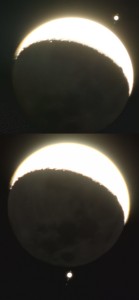
Date- 8-9-05, 8-10-05
Location- Sugarloaf State Park, Kenwood, CA
Time- 9:30-3:30, 9:30-3:00
Objects observed- 8-9-05 (M13, M8, M20/21, M22, M57, M27, M17, M16, NGC 7000, Veil Nebula, NGC 6781)
8-10-05 (B142, 143, NGC 6709, NGC 6752, NGC6751, NGC 6818, M10, M12, M14, M9, M107, M2, M31,)
LM- 6.8+
Equipment- XT8 Orion Classic Dob, 17mm Lanthanum, 0-111 Orion filter, 25mm MA Meade, 9mm MA Meade, 18mm WA Meade, 8x42 Nikon Monarch Binocs.
I had been planning to get to some dark skies for about 3 months now, and I decided to incorporate it into my families camping trip. I thought tops, the skies would be mag. 5.5, but I was wrong! It was also predicted cloudy for both nights, but it stayed clear! I know… you’re jealous, but the park is really easy for people in the bay area to get to. Anyway, in addition to the dark skies, the park is fantastic. This place is made for astronomy. There is an observatory housing a 40 inch scope, a 12 inch, and an 8 inch. Unfortunately, it was closed while I was there. They also have a “Planet Walk” that is the solar system to scale over a 5 mile course. In addition to all of this, there are fabulous trails throughout the park. Anyway, you can see everything in the sky except for the Scorpios/Sagittarius section, but that’s just a minor setback. The moon set early, so it was perfect timing as far as spontaneous astronomy goes.
8-9-05
The first night was a real shocker, because it was cloudy all day until 6 o’clock. I setup around 9 thinking I’d get some quick observing in then sit around at the campfire, but the second it darkened, I knew I would be out for awhile. My brother spent the whole night out too. When everything got dark, I was shocked. It was pitch black, with millions of punches in the sky, and an annoyingly bright cloud directly overhead. O wait, that was the Milky Way. I got my red flashlight out to plan some stuff with Sky Atlas 2000, but I didn’t need it. I could read by the Milky Way’s light. We started the night with some eye candy…
Hercules was very bright and M13 was visible to the naked eye, so I pushed the scope over there first. M13 filled most of the FOV in my 17mm, and under Barlow the field was resolved into thousands of stars. It was extremely bright, it actually hurt a little!
I then slewed over to Sagittarius which was setting behind a mountain. I took a quick peak at M22, which showed its open cluster quality to me very well. After that I started something I like to call my “celestial train ride” I go over to M8, and follow the DSI’s above it, finishing with M16. M8 knocked my sox off, it was my favorite in the ride. I used an O-111 and the nebulosity extended out of the FOV. The star cluster in it showed up nicely too. I detected a bit of pink it also. Next up was M20. I could see the trifid part of it with direct vision. It was like a photograph with no color. Up next was M17. This was my second favorite in the chain. With the O-111 it was hard to detect the swan because there was so much nebulosity surrounding the famous part. It showed more of the “Omega” quality. The last part of the ride, the Eagle was equally fantastic. The nebulosity showed up better without an 0-111, and it was even throughout the object.
Then I spent some time in the Summer Triangle, where the Milky Way was at its nicest. First was M57. I didn’t notice much difference at the site than from the suburbs. Up next was M27, my favorite of the night. I got to see this in an 18 inch at Mt. Diablo awhile ago, and the view with my 8 inch surpassed it greatly. I could see the horns with an O-111 easily, and it looked more like a ball than a dumbbell. Next was the Veil Nebula. This one was incredible with an O-111 and a 25mm. Truly an amazing experience seeing the elegant wisps spread out over such a wide field. As I was preparing to go to the “Medusa” Nebula, I caught a brighter patch of the Milky Way with my naked eye that I had never seen before. It was next to Deneb, and I immediately knew what it was, The North American Nebula. With binoculars, I could see the Pelican too. The last object of the night, NGC 6781 was the most pleasing to find. This rather large planetary nebula was an even patch of light with the 0-111, but without it I could see brighter blotches. I could also see the “trail” of it with the O-111.
After that I realized my brother had been counting satellites. His total was about 22. He had seen many fireballs, and said I should watch. Literally the second I sat down, I saw a -15 fireball that made a pop as it streaked across the entire sky. The tail was still visible 30 seconds after it appeared, and it was a greenish/bluish color. After another hour of 10 -8 fireballs, we decided it was time to head in.
8-10-05
This night was much warmer than the night before, and had much better seeing. I saw Jupiter with binoculars around 8:00, a new record for me. I got Venus around 6:00. I spent the first hour touring Ophiuchus, and saw my favorite globular to date, M10. Not only is it my favorite globular, but it’s my favorite binocular globular too. It is very large, and very bright too. I could resolve some in the binocs. Next was M12, which was practically identical. After that was M107, which resembled M71 and 72. After that I went to M14. It was a little tough to find at first, but I eventually got it. I couldn’t resolve many stars, but it was still very nice. M9 was the last one I saw in that region, and it was like M14.
Next I spent some time in Aquila. First was B142 and 143. No matter how hard I tried, I could not see the E shape of it, but they were definitely there. After that was NGC 6709. This open cluster was like NGC 7789, but a little looser. I didn’t spend too much time observing this one, but I saw a lot of yellow and red members.
After that I realized I had forgotten about the little gem. I pushed my scope toward Sagittarius and with little ease, I saw it. It was very green and rather small. I tried to locate The Irregular galaxy NGC 6822 below it, but couldn’t find it. After that I went to NGC 6751 which proved very hard to see. It was the same color as NGC 6818, but about 4 magnitudes fainter. Then I went to my favorite planetary of the night, NGC 6752, the blue snowball. It was turquoise to me, and about the same size as the Saturn Nebula. I then quickly found M2 because I wanted to compare it to back home, and it was about the same because of its bad position in the sky.
Last of the night, and my favorite out of both evenings, was M31. I was scanning Cassiopeia with binoculars, and saw a remarkable nucleus with two flanking tails. I had no idea what it was because it was so magnificent, and surely it had to be a comet I wasn’t aware of. I looked at it in my scope, and saw some distinctive features…2 smaller satellites, a bright core, a dark lane… I knew this was Andromeda. It looked exactly like the photos, except it was blue.
I would’ve spent more than an hour soaking it all up if it weren’t for that pesky wildlife… I guess that’s the tradeoff for dark skies. A “Puma Colores” made a roar and killed a deer that was only 30 feet off. Adrenaline pumped, and the scope was in the car in no time.
I had never experienced anything like this in my life before, and can’t wait to go back to this site. If you live in CA, ask me for directions.
-Zack
http://www.freewebs.com/mehball/
 They have an unusual 8" triplet refractor, and a very nice C14 CCD setup on a Paramount mount.
