Check out the following picture of M106. Yeah, I took that with my 4.5" DS reflector  . It's actually a picture I downloaded from Astronomy Picture of the Day (http://antwrp.gsfc.nasa.gov/apod/astropix.html). I sometimes use them as my background on my computer screen. But here's the thing: the blurb on the website indicates that M106 is a Seyfert type galaxy, which has a very bright core that is supposedly powered by a massive black hole.
If that is the case, then could the spiral arms of these galaxies (and perhaps others) be explained by the rotational effect of matter being pulled in towards the core by the overwhelming gravitational power of the central black hole? Could we, in fact, be looking at a vast celestial drain? Compare the picture to water going down the drain in your sink. Are they not similar? Is the Whirlpool galaxy (M51) exactly that?
If this is in fact the case, then can we assume that the galaxy in question is rotating clockwise?
Can such a hypothesis be tested, or is the rotational period of galaxies so long that their movement escapes detection?
Just some thoughts. I know it's off-topic, but I couldn't help but be intrigued by this picture and what it seems to suggest.
Clear nights ... dark sites,
Darren
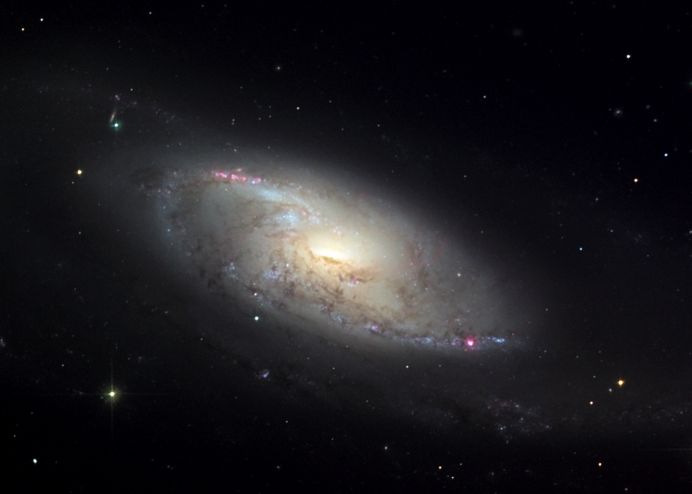
. It's actually a picture I downloaded from Astronomy Picture of the Day (http://antwrp.gsfc.nasa.gov/apod/astropix.html). I sometimes use them as my background on my computer screen. But here's the thing: the blurb on the website indicates that M106 is a Seyfert type galaxy, which has a very bright core that is supposedly powered by a massive black hole.If that is the case, then could the spiral arms of these galaxies (and perhaps others) be explained by the rotational effect of matter being pulled in towards the core by the overwhelming gravitational power of the central black hole? Could we, in fact, be looking at a vast celestial drain? Compare the picture to water going down the drain in your sink. Are they not similar? Is the Whirlpool galaxy (M51) exactly that?
If this is in fact the case, then can we assume that the galaxy in question is rotating clockwise?
Can such a hypothesis be tested, or is the rotational period of galaxies so long that their movement escapes detection?
Just some thoughts. I know it's off-topic, but I couldn't help but be intrigued by this picture and what it seems to suggest.
Clear nights ... dark sites,
Darren
Attached Image:

