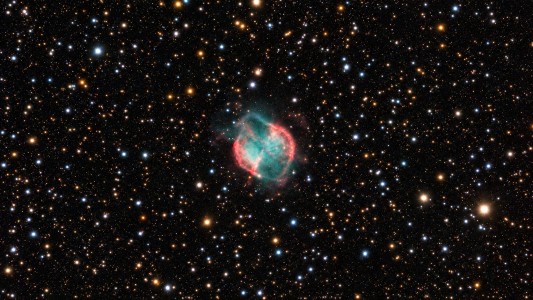
Observig log, Apr 26, 2003
Location: Port Stanley, Ont.
Equipment: 4.5" Bushnell Newtonian, focal length 900mm, f/7.9, GE mount
Eyepeices: 20mm, 10mm, 6.7mm plossls
Got invited to a friend's farm on Lake Erie, outside of London, Ontario. He is the president of the astronomy club where I live (York Region Amateur Astronomers), and often has club members down for an observing session. So I packed up Heep (my dept. store 4.5" Newt, so christened because it is so very 'umble) and drove down for the night. The only other place I've been observing is on my light-strewn front lawn. Here, there was not another source of light for miles.
Well, let me tell you, what a difference. Aperture doesn't rule. Dark skies do. We started in the evening twilight, on Jupiter and Saturn, but wind off the lake prevented us from getting any decent views. I tried to locate M1, but no luck. I got a beautiful view of M35 in both Heep and my buddy's tripod mounted 20X80 binoculars.
Moving on to Cancer, I got a pretty view of M44 in those same bino's, and in my scope, the whole cluster looked much brighter than in my suburban front yard.
We forsook the galaxies in Leo and Virgo (they wouldn't look like much in a 4.5" Newt anyway), so we swung over to the east to get a view of the late spring/early summer objects. I was able to find M13 (first time in this scope) and was even able to resolve individual stars at the edges using my 10mm plossl (90X). I was also able to track down M57 (first time ever!), which showed a somewhat darker core at 90X, and was surprisingly bright. It sort of looked like a dime.
Later, as Lyra and Cygnus were higher in the sky, we saw Scorpius and Sagittarius appear in the southeast. Eventually, we could actually make out the shape of the Milky Way, from the thin dust-cloaked edges of the spiral arms to the bulging central core as Sag rose higher above the southern horizon.
Seeing was spectacular in the south, and I was able to bag several more globulars, including M12 in Ophiuchus, M22 in Sag, and M4 and M80 in Scorpius. Sweeping with the scope just about anywhere in the region produced dazzling discoveries. The Lagoon showed at least two dozen stars, plus dark lanes intersecting a bright central cloud in Heep, and both it and M20 were visible in the bino's. I found M17 quite by accident just slewwing around in Sag - beautiful. At first I didn't know what I was looking at, but its appearance was quite suggestive of its nickname - the Swan.
All in all, a fantastic night of viewing. The naked-eye view of so many faint stars was staggering. All of the seven Little Dipper stars were visible, and a few others besides. Every constellation was laden with dozens of hitherto-unseen jewels. I saw more different objects on that one night than every other night put together since purchasing Heep in December.
Clear nights ... Dark sites,
Darren

