Image of the day

Captured by
John Roach

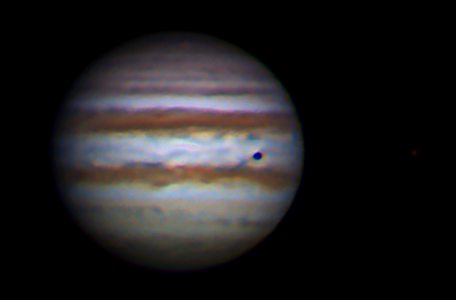
Jupiter IO Transit 12-10-26

My Account

New to Astromart?

Register an account...

Need Help?

North America Nebula, hard to see?

Started by proteus, 10/21/2006 05:03PM
Posted 10/21/2006 05:03PM | Edited 10/21/2006 05:34PM Opening Post
We tried the North America Nebula the other night using a 9.25 f/10 SCT and various wide field eps up to 40mm. We noticed nebulosity in the region, but were unable to discern much, even with O111 or UHC filters. Seeing was very good and the veil nebula was beautiful.

My question is, how hard is it to see this North America nebula?

Sorry, originally called it North American, so edited
Posted 10/21/2006 05:13PM #1
I've seen it best w/ my Anteres binoculars w/ OIII filters.
Posted 10/21/2006 05:52PM #2
At f/10, it would be hard to navigate this large nebula. Look for the 'Mexican gulf', which is darker that its surroundings, with the help of a good detailed atlas; then proceed to Mexico, Florida, and up North.

A short refractor or binocular is better to view the whole nebula. UHC filter helps a lot.

I agree that it is often easy with unaided eye - when the sky is dark. With some practice, it will be pretty easy to see in SCT too - and then you can start studying the details at high power with filter.

Dmitri
Posted 10/21/2006 06:31PM #3
Joe Conway said:

We tried the North America Nebula the other night using a 9.25 f/10 SCT and various wide field eps up to 40mm. We noticed nebulosity in the region, but were unable to discern much, even with O111 or UHC filters. Seeing was very good and the veil nebula was beautiful.

My question is, how hard is it to see this North America nebula?

Sorry, originally called it North American, so edited

Joe,

I have not found it too difficult to see the NA, especially when using a UHC filter. You mention that seeing was good, but for this object transparency is paramount. That and a wide field of view.

I've seen the NA from my ~5.5 mag skies in my 6-inch scope with and without a UHC. With the UHC I was able to glimpse the Pelican with averted vision. But at 1200mm focal length and the EPs I was using I had a 2.2-degree FOV.

I ran some numbers for your setup (you did not mention whether you were using 2-inch EPs). But with a 2-inch EP your FOV is going to max out around 1 degree; 0.7 if you are using 1.25-inch EPs. The NA is approximately 2-degrees in apparent size. With a smaller FOV it would be harder, but not impossible (especially the brightest area near the "Gulf of Mexico").


Regards,
Louis Marchesi
[COLOR="Gray"]New London Township, PA[/COLOR]
Posted 10/22/2006 12:23AM #4
You need at least a 3 degree field to fit the whole thing so you can see the shape. No way you'll do that with a SCT. With your setup all you can do is scan over it bit by bit. The most obvious part is the black Gulf of Mexico rimmed by Florida through Mexico.

Joe Bergeron

Moderator, Astro-Physics Forum
Posted 10/22/2006 01:11AM #5
Joe,

The NA nebula is really large -- too large to fit in the field of view of your C9.25, that's why you're not finding it. You need to go to something with much lower power (like binoculars or a wide-field refractor).

Now that I've seen it (with my 100mm refractor) and know what to look for, I can see *parts* of it with my C9.25 and 31mm eyepiece.

Richard

C9.25/SV105/SV80s/P-SM60
G11/GM8/M4
Posted 10/22/2006 08:18AM #6
With a telescope where you can't go very low in magnification the nebula appears very large and ill-defined. However, it shouldn't be difficult to detect it with your telescope under dark skies.
I use a very simple trick to bring out very diffuse nebulosity. I gently swing the telescope from side to side (a movement of some 30 - 50% of the field of view). This makes large and diffuse objects more easy to spot, and as soon as your eyes have discovered the object, you can stop the movement, and it will still be visible.

Inge S
Posted 10/23/2006 02:39PM #7
Thank you all for answering. We did find the gulf, which was the area that allowed us to know we had part of the nebula in the field. I'll try panning around it the next time.
Posted 10/24/2006 11:21AM #8
My 101mm Tele Vue refractor and 35mm Panoptic (4.4 degree TFOV) display NGC 7000 quite nicely from dark sites, particularly when an OIII filter is utilized. The nearby Pelican Nebula is a bit more difficult.

Dave Mitsky

Chance favors the prepared mind.

De gustibus non est disputandum.