Observing Report 07/19/03 (cont'd)
Equipment: Heep ('umble 4.5" DS Newtonian on EQ mount, 900mm, f/8), 16x50 bino's
Eyepeices: 20mm, 10mm, 6.7mm Meade Plossls
Location: Port Stanley, Ont. (approx. 44n, 79w)
Time: 0130 - 0700 UT
=======================================================
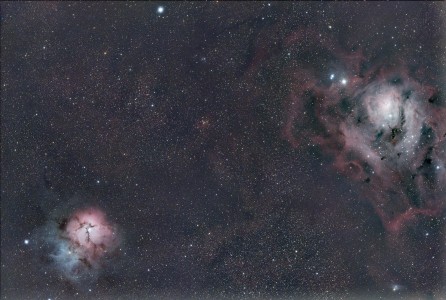
Well, on with the show. My wife and daughter were simply amazed by the naked eye view of the stars and Milky Way. I pointed out its structure, including the central core and dust lanes, to them. Both my wife and daughter got a beautiful view of M11 ay 90x through Heep, which I had no difficulty at all finding. Later on I lined up M17 (the Swan) and its delicate shape impressed them, as did Albireo and M13 in my friend's 8" SCT, showing perhaps 100 stars resolved to the core.
I couldn't seem to locate M8 for some reason (which is a stunning object under dark skies) but I consoled myself with an excellent view of M4 through Heep. It was very well resolved, showing a loose core. A line of bright stars bissecting the core was completely resolved.
Views of the Moon after it rose, through the huge bino's was amazing. One almost felt as though one were suspended in space a few hundred yards above it. But the most remarkable sight through this instrument had to be the double cluster. I got a sensation of depth, almost as though I were immersed in the clusters. Astonishing.
Mars through Heep and my buddy's SCT was a fantastic sight. I got both polar caps, the southern cap much brighter than the northern one. I even bumped up the magnification to 180x using my friend's Barlow, and the image stayed together quite well, showing faint dark brown surface markings on a salmon-coloured background. Also got one of it's moons! (At least according to my buddy). I had thought you needed a 15" or better to see them.
But the highlight of the night for me had to be M22. This was the first time I had seen it, and it was huge, well resolved, and breathtaking. The outer edges were resolved into dozens of stars, and the whole thing was much bigger and brighter than M13. It was stunning, blowing every other glob I've seen right out of the water.
We called it a night at about 3:15 AM local, which allowed me the luxury of four hours' sleep before getting up and driving 2.5 hours back to Toronto so my wife could get to work on time.
Spent most of the following day blissfully unconscious.
Clear nights ... dark sites,
Darren
