
The human body at its most quiescent (basal metabolism) puts out as much heat as a 75 watt light bulb; with a moderate amount of walking around, you can double this. Unless you are fortunate enough to have a breeze that dissipates this heat away from your optical tube, you may in fact be adding considerably to the thermal distortion of your Dobsonian's optics! With my old standby solid tube Dob, I had nearly 3/4" of Sonotube and similar insulating materials between my body and the optical path. With a truss tube scope, you have only a Lycra shroud-- at best! (Lots of folks seem to like to 'go naked' at dark sky sites to better ventilate their mirrors.)
Point your telescope at a bright star or planet and defocus the optics until the disc fills the whole field of view. Even putting your hand on the edge of the upper cage will cause dramatic currents to form! Now imagine how much more heat your head and upper torso give off... and how, if the winds are blowing from your back, they can be carrying this plume right across the optical path! Kinda' defeats the purpose of using fans to cool your mirrors and making certain that your collimation is dead on...
I would expect this to be especially pernicious in planetary viewing, and as a fairly regular Mars observer, I will be testing various simple thermal solutions out between now and opposition or longer. The first one I put in when I went to my favorite dark sky site was to take an old closed cell foam backpackers' sleeping pad and wrap it around the upper two-thirds of the OTA, securing it with bungie cords. These pads are lightweight, cheap, and thermally insulating enough that you can sleep atop one laid directly on snow and not melt it! I plan to make short segments of this same material to put on the upper cage-- since the light baffle is probably little better at thermal insulation than the Lycra shroud, and may experiment with making an extension to protrude above the upper cage assembly by a foot or so on the side facing the observer to deflect the rising thermal plume.
Has anyone else tried options like this to minimize thermal intereference with optical performance, or are we all collectively fixated on dealing with heat "at the mirror's edge"?
Jim
This is an excerpt from some experimentation I am documenting on the "new posts" section of my ATM home page
http://users.adelphia.net/~jbrspace
Point your telescope at a bright star or planet and defocus the optics until the disc fills the whole field of view. Even putting your hand on the edge of the upper cage will cause dramatic currents to form! Now imagine how much more heat your head and upper torso give off... and how, if the winds are blowing from your back, they can be carrying this plume right across the optical path! Kinda' defeats the purpose of using fans to cool your mirrors and making certain that your collimation is dead on...
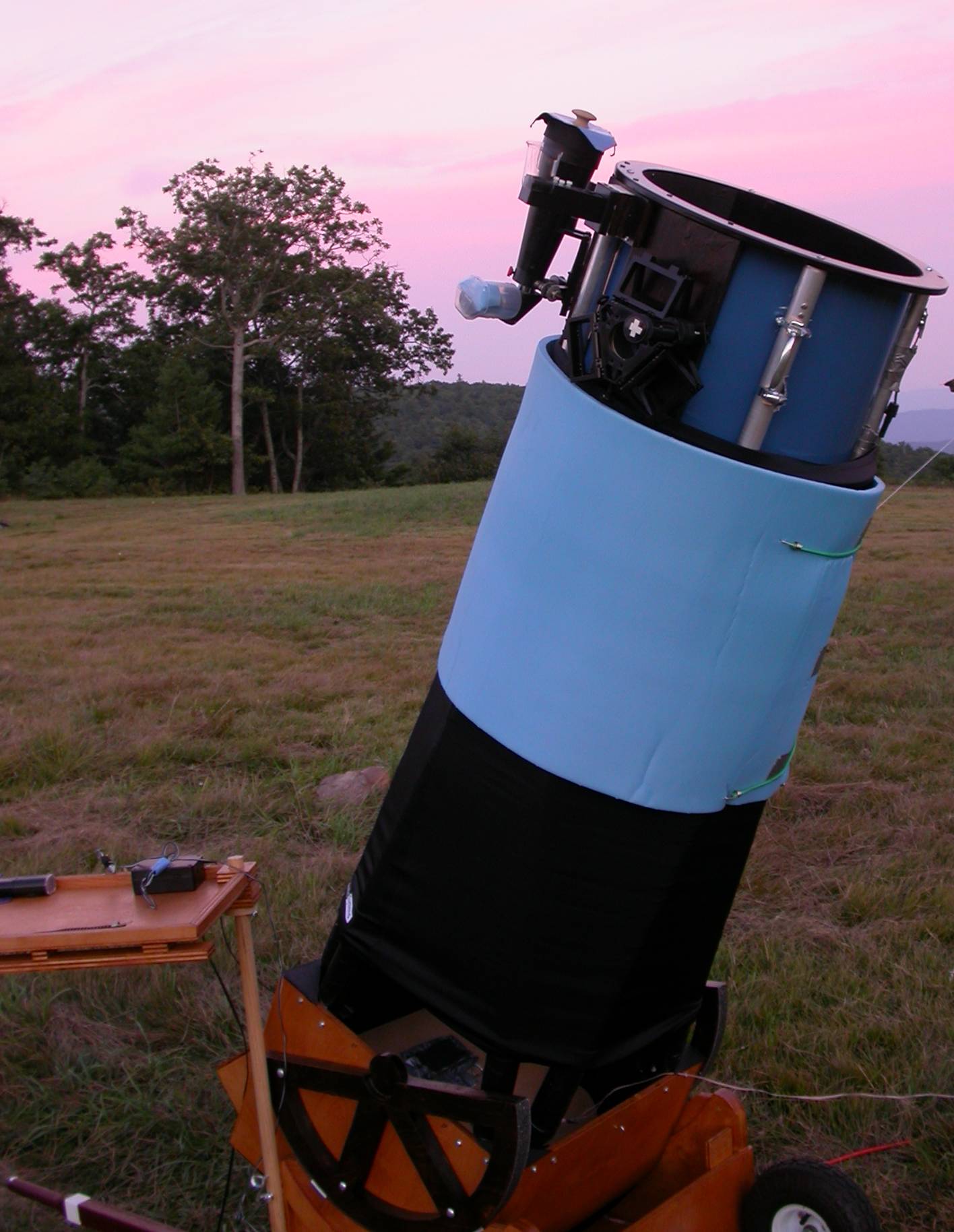
I would expect this to be especially pernicious in planetary viewing, and as a fairly regular Mars observer, I will be testing various simple thermal solutions out between now and opposition or longer. The first one I put in when I went to my favorite dark sky site was to take an old closed cell foam backpackers' sleeping pad and wrap it around the upper two-thirds of the OTA, securing it with bungie cords. These pads are lightweight, cheap, and thermally insulating enough that you can sleep atop one laid directly on snow and not melt it! I plan to make short segments of this same material to put on the upper cage-- since the light baffle is probably little better at thermal insulation than the Lycra shroud, and may experiment with making an extension to protrude above the upper cage assembly by a foot or so on the side facing the observer to deflect the rising thermal plume.
Has anyone else tried options like this to minimize thermal intereference with optical performance, or are we all collectively fixated on dealing with heat "at the mirror's edge"?
Jim
This is an excerpt from some experimentation I am documenting on the "new posts" section of my ATM home page
http://users.adelphia.net/~jbrspace
Attached Image:
