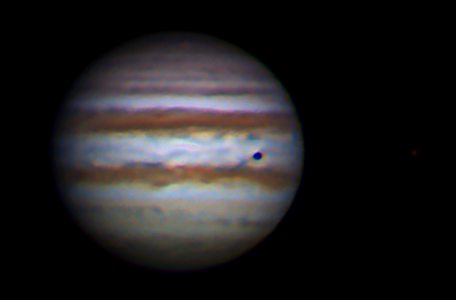
I have read so many posts about using 250x, 300x, 400x and more with 4" & 6" refractors, that I'm beginning to feel like I'm doing something wrong. What are the typical magnifications you use for planetary observing? thank you, Bill
What are typical mags used for planetary viewing?
Started by Bill in Ballard, 04/22/2005 03:43PM
Posted 04/22/2005 03:43PM
Opening Post
Posted 04/22/2005 05:09PM
#1
Bill
In really excellent seeing conditions I will end up using 50X per inch of aperture in premium apos on Saturn, and rarely more than 250 to 300X on Jupiter regardless of aperture (including in a 20 inch Starmaster with Zambuto mirror.) On lunar detail I may approach the mags used on Saturn.
In really excellent seeing conditions I will end up using 50X per inch of aperture in premium apos on Saturn, and rarely more than 250 to 300X on Jupiter regardless of aperture (including in a 20 inch Starmaster with Zambuto mirror.) On lunar detail I may approach the mags used on Saturn.
Posted 04/22/2005 06:36PM
#2
I live in Seattle. The skies are frequently very turbulent and we do have significant light pollution. I have had many wonderful views of Saturn with Cassini's division distinct and some shading on the planet.
Jupiter has been more challenging: although image size increases,low contrast details fade as mags. get much over 200x. My goal with Jupiter is to resolve the GRS (when visible) & I'm not sure at what range of mag. that should occur.
thank you, Bill
Jupiter has been more challenging: although image size increases,low contrast details fade as mags. get much over 200x. My goal with Jupiter is to resolve the GRS (when visible) & I'm not sure at what range of mag. that should occur.
thank you, Bill
Posted 04/22/2005 08:21PM
| Edited 04/22/2005 08:24PM
#3
Reading these post's reminds me of something. Although it is likely that you are all well aware of this for the benefit of some one new reading this thread it should also be remembered that the collimation and or alignment of what ever type of optics being used does come into play when using powers that exceed the 50x by one inch of aperature rule. Most folks that I know who like to do allot of high power observing i.e. Planets and Lunar usually make frequent checks to make sure that their optics are as fine tuned as they can make them. As we all know a scopes optics can be off to a significant degree and it will not be that noticeable at lower powers particularly with the less experienced observer. I realize that I am sounding like I am "preaching to the choir" but as I said this post is just to cover the bases for some less informed.
Thanks for putting up with me,
Dan
"We create moments of grace in a world that does not always expect acts of kindness."
Thanks for putting up with me,
Dan
"We create moments of grace in a world that does not always expect acts of kindness."
Danny Halstead
Moderator APM Forum
Posted 04/24/2005 07:00PM
#5
Thank you for all of your input. I must resign myself to the fact that I live in Seattle where the skies even on the best of nights, are no better than average. I do feel reassured that conditions are most likely the limiting factors than anything I am doing or wrong with my scopes.
I would love to take an observing trip out of this marine/metro environment into eastern Washington and see the difference. thanks again, Bill
I would love to take an observing trip out of this marine/metro environment into eastern Washington and see the difference. thanks again, Bill
Funding Member
