My previous numbers for the color correction in the
Orion ED-80 led to some interesting comments and
controversy. I went back and repeated them using a CCD
camera. Rather than measure focus shifts, I decide to
simply present the star images in the three different
colors -- violet, green, and red. The scopes were all
focused for the green filter, and then I took the violet
and red images without changing the focus, so you get some
feel for the chromatic and other aberrations.
There had been a comment that maybe while the ED-80 had
a small focal shift, it might have bad chromo-spherical
which was not really addressed by the focus shift number.
I thought posting the images would help resolve this issue.
As you can see, there is no significant spherical in
the violet; maybe theres is a little bit in the red.
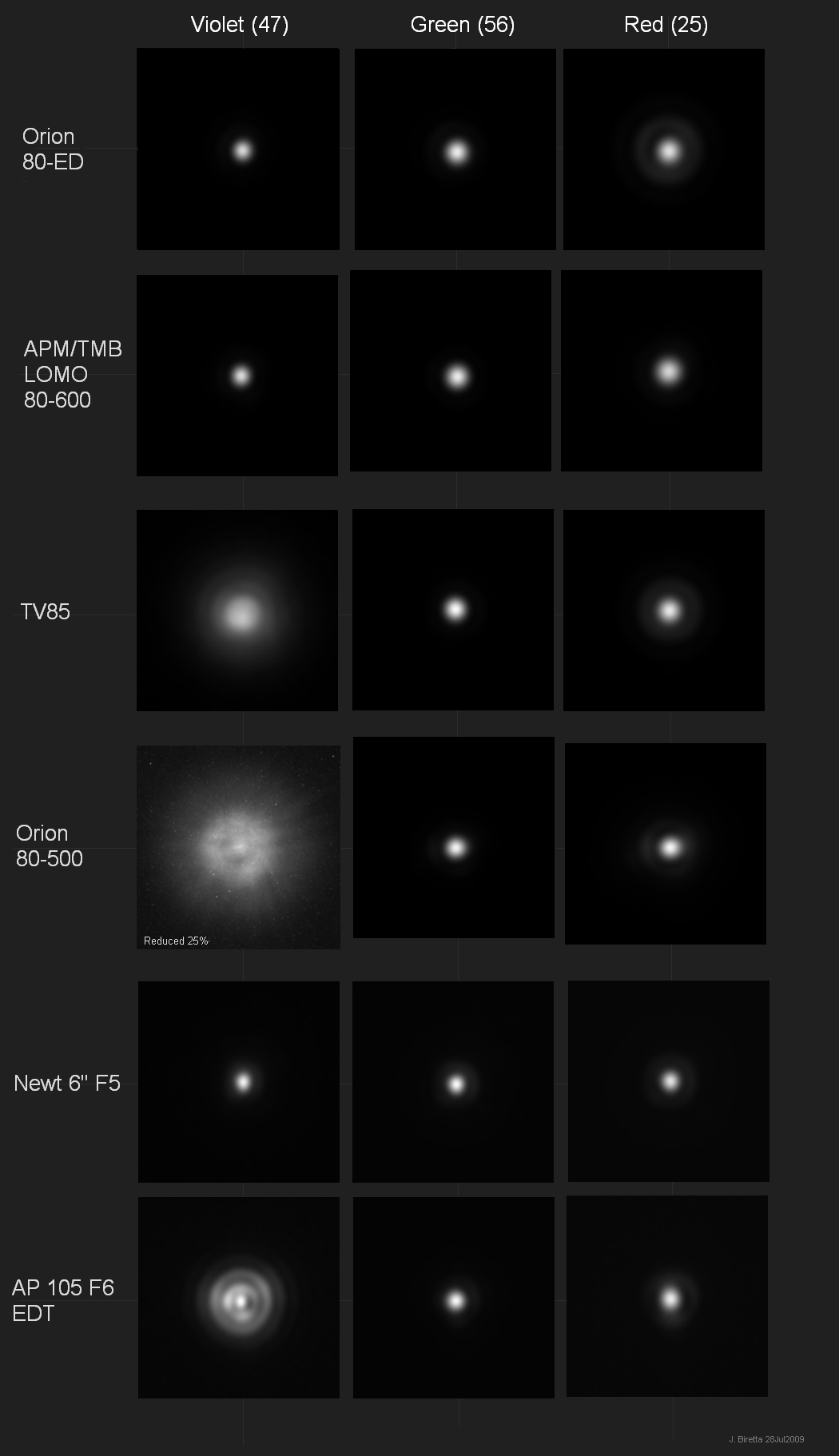
The attached image shows the results for the Orion 80-ED,
TMB 80/600, TV85, Orion 80/500, 6" F5 Newtonian, and the
AP Traveler. Color runs left-to-right violet, green, red.
Some notes on the individual scopes:
Orion 80-ED: Green and Violet are both well focused.
Red is a little soft -- some extra light in the Airy ring
-- a lot like the TV85 in the red. Good Airy disks
in all colors. Very close to the TMB. No evidence for
significant spherical error in violet. This is an ED doublet.
TMB 80/600: Nearly text-book perfect images in all
three colors. This is labeled "Super APO" on the lens,
whatever that means. It looks pretty good. This is
an air-spaced ED triplet lens.
TV85: Green is OK. Red definitely soft. Violet is
a fuzz ball; lots of de-focus, etc. ED doublet lens.
Orion 80/500: This has sometimes been called semi-APO, etc.
It is more or less identical to the old University Optics
80 mm scope. Green gives a good image. Red is soft
- some light in the first Airy ring. Violet is
far out of focus -- I had to shrink the image by 4x to fit it in
(some hot pixels in the CCD also show up in the violet image
due to long exposures). Doublet lens; glasses rumored to be
FK5 and SF2.
Newtonian 6" F5: Good focus at all three filters.
A little coma and other aberrations in the violet.
I included the Newt just to check there were no errors
in my setup or method.
AP Traveler 105 F6 EDT: Reasonably good image in the
green. Red is a little soft. Violet has about 1 wave
defocus and some combination low and high-order spherical.
I repeated this one three times to make sure. This is
of course an F6 scope, vs. the others around F7 to F7.5,
so a little more color/aberration is expected. This is
an oiled ED triplet lens.
How images were made: These are all lab measurements
on an optical bench. I used a 16" collimator which effectively
projects an artificial star at infinity.
Setup is collimator - scope - TV 5x PowerMate - filter -
Imaging Source DMK CCD camera. Images are all at the same
pixel scale (except Orion 80/500 in violet) -- you will notice
the Airy disk is smaller in violet, and smaller for faster
F-ratios, as expected. The scope was focused using
the green filter. Then images were taken in green, violet, red.
Then focus was checked again in the green filter. I exposed
for about 1 minute in each filter at about 8 fps, and then
stacked in K3CDD, and stretched the contrast to put the peak
around 230/255 counts, but no other processing.
I think the bottom line is still unchanged from previous
discussion. Whatever you call the ED-80, it is a very fine
scope. The optics compare very well to other refractors
costing 3-5 times more $$.
I should also add, of course, these are tests on one particular
randomly selected sample of each model. The one you get might
be better or worse, etc.
Attached Image: