Image of the day

Captured by
John Roach

Jupiter IO Transit 12-10-26

My Account

New to Astromart?

Register an account...

Need Help?

TEC 160FL better color correction than TOA?

Started by jerrywise, 11/05/2009 02:10AM
Posted 11/05/2009 02:10AM Opening Post
Like many, I'm in a holding pattern until I get my EMail from AP on a 140, 160 or 1xx anything. My current scope is a TOA 150 and it does a fine job, both visual and DSLR photography. I'm moving from DSLR (or splitting my time anyway) to entry level CCD now that SBIG is coming out with the 8300. With the extremely rare nights of good seeing in this area I want to optimize every minute under the stars. I was looking at the TEC 160FL and TEC 160 wondering what the difference would be between the two and how they compare with the TOA 150. Discarding the 10mm difference would the TOA color correction approximate the 160 or 160FL? (The TOA 150 is $8,995, the TEC 160 is $8,800 and the TEC 160FL is $12,500.)

AP-140 AP-1200 Mach 1
Posted 11/05/2009 04:01AM #1
Some of the most awe inspiring pics I've seen of the heavens have been done with both lines.

I don't think there's a wrong choice here. One may require you to process a bit this way, the other that way. I would suggest you consider technical aspects such as total weight in relation to mount capacity, field of view, benefits of an extra 10mm aperture, and so on. I'm not sure color correction is going to be a decisive intervening variable.

For the simple reason that you're doing comparisons among some of the finest refractors available in the world.

You make me feel kinda bad, ya know. My "waiting for AP" scope is a cheapo FS128. What a bummer....

Greg N

"Scope will get you through times of no money better than money will get you through times of no scope." --Freewheelin' Franklin
Posted 11/05/2009 02:54PM | Edited 11/05/2009 02:54PM #2
Jerry Wise said:

Like many, I'm in a holding pattern until I get my EMail from AP on a 140, 160 or 1xx anything. My current scope is a TOA 150 and it does a fine job, both visual and DSLR photography. I'm moving from DSLR (or splitting my time anyway) to entry level CCD now that SBIG is coming out with the 8300. With the extremely rare nights of good seeing in this area I want to optimize every minute under the stars. I was looking at the TEC 160FL and TEC 160 wondering what the difference would be between the two and how they compare with the TOA 150. Discarding the 10mm difference would the TOA color correction approximate the 160 or 160FL? (The TOA 150 is $8,995, the TEC 160 is $8,800 and the TEC 160FL is $12,500.)

Hi Jerry:

My understanding is that the color correction of a TOA refractor is about as good as can be done. I would think that other than the 10mm aperture difference, the only reasons one might prefer a TEC 160 over a TOA 150 would be more mechanical than optical. These scopes have different weights, different focusers, different cool-down characteristics etc. I can’t imagine an imager being disappointed with either one.

Jim


Posted 11/07/2009 06:19PM #3
I think the problem you will run into is finding someone (anyone) who has experience with more than one of these three fine scopes.

My expectation would be that the TEC 160FL and Tak TOE 150 would have essentially perfect color correction followed by the TEC 160ED. However, that is based purely on reputation and user reports, not based on any actual experience or having seen a side-by-side comparison.

If it were me, as an imager I would go for either the TEC 160FL or the Tak TOE 150 (or even the LZOS 152) rather than the TEC 160ED. If I were a visual observer, I would probably swap this recommendation. As it happens, I own an LZOS/TMB/APM 152 that I am extremely pleased with as an imaging scope. I chose it over the Tak and TEC options because it was available used from someone I trusted, not because I thought it was a better scope per se.

- Jared Willson
Posted 11/08/2009 12:28AM #4
From my own visual star tests, and results posted in various places
on the web, I believe you will find the TOA 150 has the best color correction
of the four you mention, with the TEC 160 FL and AP 160 being close
behind. The TEC 160 ED would come in a slightly distant 4th place.

That said all four will be significantly better than ED doublets or
achromats. I would also add some caveats that the imaging performance
might be different owing to the much higher sensitivity in the far-violet
of some CCD cameras as compared to the eye.

Various inputs to the above view point are:

Star tests I have done (not side-by-side) on AP 160, TEC 160 FL,
and TEC 160 ED. Also star tests side-by-side of AP 155 and TEC 160 ED,
and the design similarity of the AP 155 and AP 160.

Comparison of TOA 150 and AP 160 at
http://homepage3.nifty.com/cz_telesco/refracter_test.htm
They are the last two scopes on that page.

Also the heritage of the TOA line and the near-perfect color
correction of the TOA 130 as shown on the Japanese site and also
http://www.astro-foren.de/showthread.php?p=37670#post37670
http://www.astro-foren.de/showthread.php?p=41561#post41561

... would the TOA color correction approximate the 160 or 160FL?
Posted 11/09/2009 03:44PM #5
Theoretically the TOA has the best color correction of any present commercially available refractor. Reason is that it has 2 wide airspaces which are used as two extra elements to correct for sphero-chromatism (spherical over and undercorrection at the ends of the spectrum).

Close airspaced lenses using FPL53 and BK7 are next in color correction, and depending on the focal ratio, will have some sphero-chromatism.

Oil spaced lenses can have similar color correction depending on the active element (Fluorite or ED) and mating glass, and they will also have some sphero-chromatism depending on F-ratio.

Oil spaced and close airspaced lenses will have fastest cooldown time. Wide airspaced lenses (like the TOA) are less stable in dropping temperatures, which may negate the lower spherochromatism of this design.

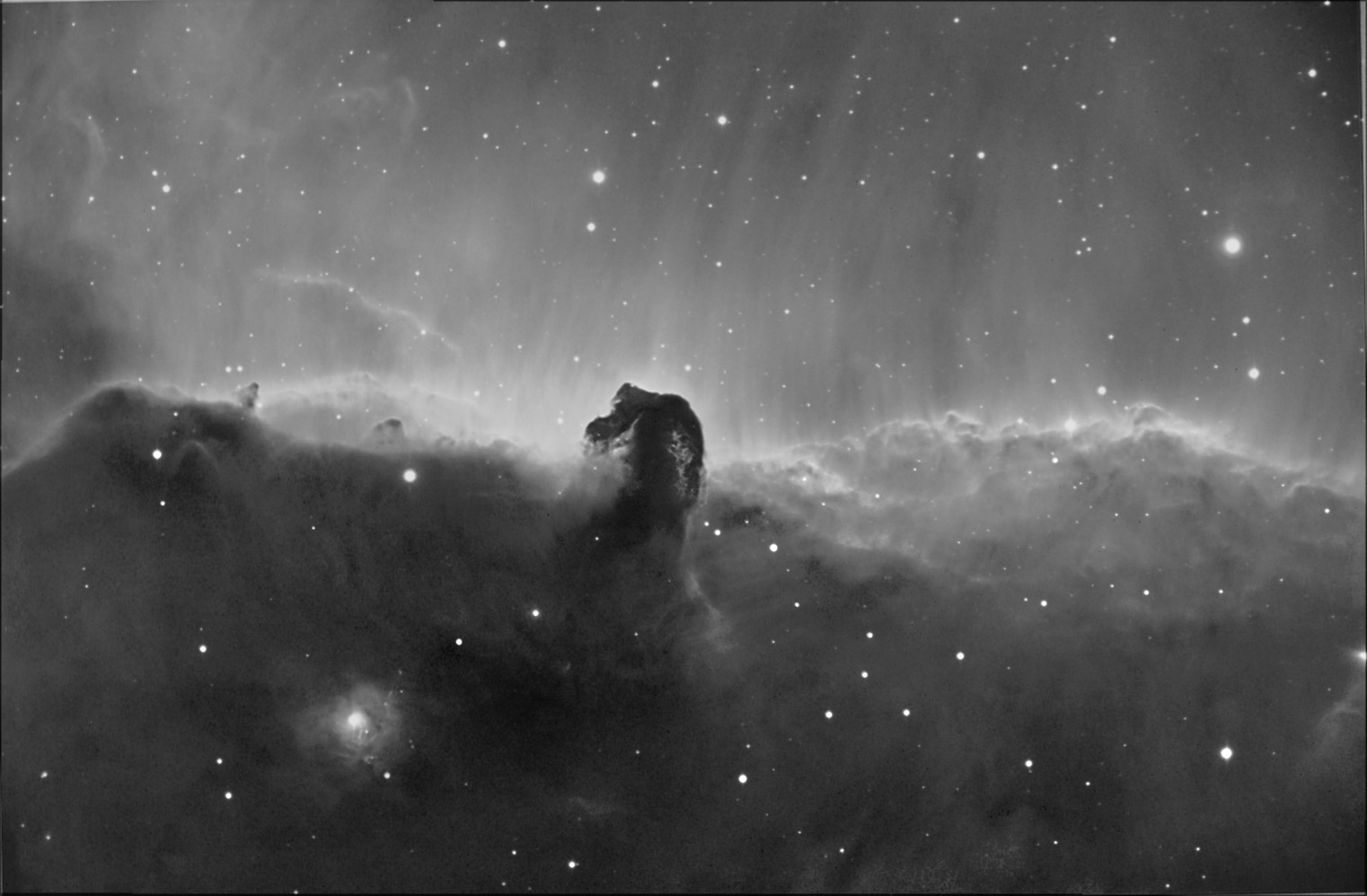
All of the above will work quite nicely for visual and imaging applications. See attached image of Horsehead taken with a 155 EDF lens, which is an oil spaced optic with FPL53 and BK7 glass. I think you would have trouble getting any better image with any other 6" refractor, which means to say that you will achieve essentially the same result with any of the refractor designs, regardless of marketeering claims of superiority (assuming they are well figured).

Rolando

Attached Image:

RolandC's attachment for post 133806