Image of the day

Captured by
Philip Imbrogno

Pleiades M 45 with the Pleiades 68

My Account

New to Astromart?

Register an account...

Need Help?

Superior Optical Design?

Started by jtpowers1972, 02/28/2008 01:07AM
Posted 02/28/2008 01:07AM | Edited 02/28/2008 01:23AM Opening Post
For my education, I am interested in which of the following lenses is superior for CA, spherical aberration, astigmatism, etc. Also, given possible superiority of of one lens over the other, which would you rather own? One is a legendary 4" doublet, one is a legendary 80mm triplet. Hmmm...

TMB/LOMO 80/600 triplet
Vixen 102/920 doublet

Any and all comments welcome. Thanks!
Posted 02/28/2008 02:06AM #1
My impression from memory and visual testing
is that the TMB 80/600 has slightly less CA than
the Vixen 102/920, but both are really very nice.
The difference is a matter of splitting hairs.

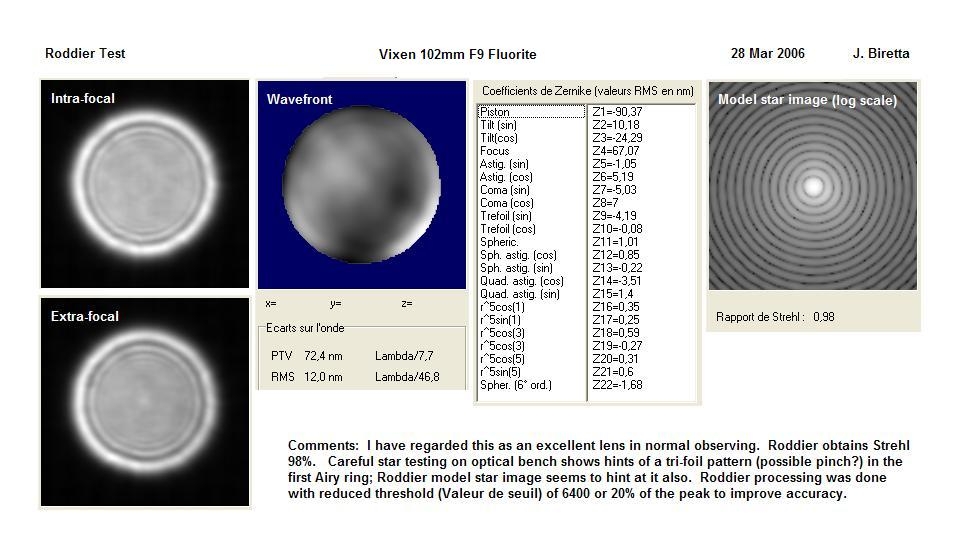
Regarding spherical and astigmatism, etc., I will attach
some Roddier test results for a Vixen indicating minimal
aberrations and Strehl 98%. I've seen several of these and
the related Celestron C102F that were very close in
performance to this one -- all had spherical better
than 1/10 wave PTV and undetectable astigmatism. None
was significantly worse. Some have very low-level
trefoil or similar aberrations -- like a pinch but
in the glass -- some sort of glass melt or uniformity
issue, but at extremely low level like 0.03 to 0.05
wave PTV.

As regards the TMB, I think you could order
whatever Strehl ratio and level of aberration you
wanted. One I tested in a similar fashion had
Strehl 99%. But I am not sure what the average
Strehl ratio would be, or what the range of values was.

Which to own? The 4" scope will show more detail on
planets. The 80mm triplet might be better for imaging
-- I am guessing it probably has better CA far in the
red and in the violet -- where the eye is not so
sensitive but detectors are.

Attached Image:

m87's attachment for post 120718
Posted 02/28/2008 07:54AM #2
Some measured CA focus shift numbers. These are
measured visually with a TV 3-6mm zoom at 3mm using
narrow band filters. The numbers are simply how far
the focuser needed to move to attain best focus
(relative to 546nm or green light).

Wavelength(nm) = 400, 486, 546, 656
(Violet, Blue, Green, Red)
Focus shift in mm (+/-0.02):
VX 102/920 = 0.26, -0.01, 0.00, -0.03
TMB 80/600 = -0.03, -0.02, 0.00, -0.07

What do they mean? Visually 486 to 656 nm is the important
range. The eye is not very sensitive at 400nm in the violet
so for most objects this can be disregarded. Between
486 and 656 the Vixen has almost no focus shift. The
TMB has a very small shift in the red (656nm). So
visually they are about the same, with the Vixen
being very slightly better in the red.

For imaging some cameras will have good sensitivity in
the violet (400nm) so this becomes a consideration, and
here the TMB has more advantage.