Image of the day

Captured by
John Greenlee

Before and after

My Account

New to Astromart?

Register an account...

Need Help?

questions regarding refractor lenses and star test

Started by Toseeka, 01/13/2008 03:13AM
Posted 01/13/2008 03:13AM Opening Post
I have several questions concerning star tests and spacing of lens elements.
1. Am I correct in assuming that, in an under-corrected lens, the diffraction rings appear more obvious and clearer inside of focus and less so outside of focus? If so, then the opposite is true for an over-corrected lens?
2. Is it the spacing of the lenses that determines the degree/type of spherical aberration? So, under/over correction would be corrected by adjusting the amount of space between elements?
3. When viewing a lens that is out of collimation through a Cheshire eyepiece, I understand that the point in collimating is to get a single black dot image in the centre of the larger white circle. Now, before this has been achieved (via collimation screws), what does it mean when the still "stray" black dot appears to be two very tiny black dots either very close or touching each other (in other words, not a single black dot)?
Bruce
Posted 01/13/2008 08:38AM | Edited 01/13/2008 12:34PM #1

1. Am I correct in assuming that, in an under-corrected lens, the diffraction rings appear more obvious and clearer inside of focus and less so outside of focus? If so, then the opposite is true for an over-corrected lens?

The star test patterns in a refractor are complicated
by chromatic effects. Also, there are many lens designs
with different properties. In the simple case of a
Fraunhofer doublet, the chromatic effects alone will
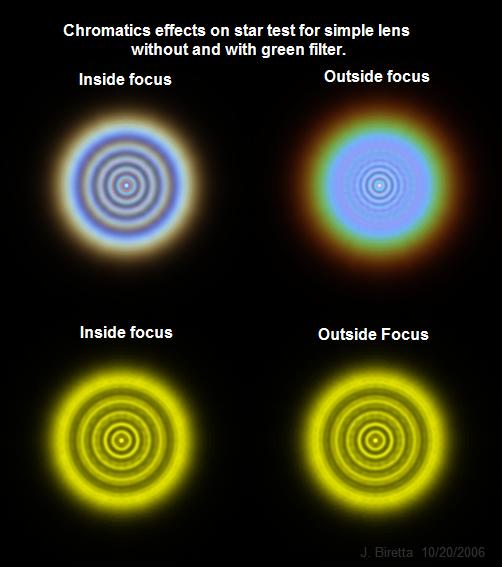
make the star test rings inside focus appear sharper
than those outside focus. This occurs because green
light is focused closest to the lens, and all other
colors are focused farther away. The attached images
simulate the effect.

Star testing will be greatly aided if you can use a
green filter, and preferable one with a narrow
band pass. This will mostly eliminate the color
effects, and let you study the spherical correction
more reliably.

Low-order spherical errors will make the center of
the star test pattern bright on one side of focus,
and the outside area of the pattern bright on the
other side of focus.

Besides color effects, narrow zones and turn-down-edge
can also make the rings less distinct on one side
of focus.

I highly recommend getting the Aberrator software from
http://aberrator.astronomy.net/
and you can make your own simulations.


2. Is it the spacing of the lenses that determines the degree/type of spherical aberration? So, under/over correction would be corrected by adjusting the amount of space between elements?

Some small adjustment in the spherical correction
can be made by changing the spacing. But for many
lens designs it is not very sensitive to the spacing,
and it is difficult to get much correction this way.
A Fraunhofer design will go under-corrected as the
spacing is increased. A 6" F8 will need about 0.7mm
spacing to move the low-order spherical by 1/4 wave PTV.
But if one of the spacers is too thick or too thin by
even 0.02mm there will be unacceptible amounts of coma;
the spacers need to be exactly the same thickness.


3. When viewing a lens that is out of collimation through a Cheshire eyepiece, I understand that the point in collimating is to get a single black dot image in the centre of the larger white circle. Now, before this has been achieved (via collimation screws), what does it mean when the still "stray" black dot appears to be two very tiny black dots either very close or touching each other (in other words, not a single black dot)?

For a doublet there will be 3 bright donuts.
The goal is to get them all on top of each other.
I think what you are seeing is that the black
spots (donut centers) are not aligned.

Attached Image:

m87's attachment for post 119613
