Image of the day

Captured by
Lawrence Parchman

Eastern Veil Nebula

My Account

New to Astromart?

Register an account...

Need Help?

Large Aperture Refractors for Visual

Started by lthaxton, 07/12/2008 01:16PM
Posted 07/12/2008 01:16PM | Edited 07/12/2008 01:33PM Opening Post
Not sure how to title this. I have been reading threads here and elsewhere about planetary scopes including the much vaunted AP "Superplanetary" scopes, TMB 130 F/9.25, APOMAX, etc. Comments were made about the 5" to 6" range of scopes more often matching the seeing than larger scopes. Most of the scopes discussed were 5" to 6" apos which led me to wonder what scopes folks prefer in larger apertures which I suppose must mean those scopes over 6". It is a wider field of possible choices than one might first first realize if one includes achromats, apos and whatever you decide to call those scopes "in between", i.e. the Meade 178ED.

For those of you who have gone to 8" or larger apos, what are the advantages and tradeoffs?

It would also be interesting to know how the larger scopes are handled- permanent installations, "portable" arrangements that are set up each time they are used? How about the obvious- are you hinderd by the large aperture meeting atmospheric limits? Also, what are your preferred planetary eyepieces. In larger achros, have you found that any particular eyepieces excells in terms of color correction?

For my part, I have owned the AP 6" F/12 Superplanetary, a Meade 178ED, D&G 8" F/12 and now a TMB 175. In moments of weakness, I consider a larger refractor ( a friend in Japan notified me of a Goto 10" F/12 objective up for auction but I was too slow) and am curious of others views. Have you ever though of going back down to a smaller refractor after buying a large scope?

Goto auction though long closed:

http://page2.auctions.yahoo.co.jp/jp/auction/b89439535


Posted 07/12/2008 02:58PM #1
You can get Barry Greiner of D&G Optical to make you a 12". Go for it. The views will be awesome.

Rolando
Posted 07/12/2008 04:06PM | Edited 07/12/2008 04:07PM #2
The issue with these larger achromats is tube length. That Goto lens sold at a nice price, but think about what a three-meter focal length actually means in terms of the mount and eyepiece locations.

Folding the path is the obvious answer to get one of these lenses into an OTA normal people might want to use. Two folding mirrors at 92% reflectivity clips the 10" lens down to 8.5"aperture. IIRC the old ATM books even had configurations using three mirrors with a fixed eyepiece position.

When all is said and done you may be better off with that 6" APO...

Jim McSheehy
Posted 07/13/2008 01:13PM | Edited 07/13/2008 01:14PM #3
I've always thought Henry Paul's suggestion for folding a large achromat had some big advantages. He recommended folding it "Newtonian style," with a large flat at the bottom of the tube. This sent the light back to the top of the tube, where a small flat sent it back across the tube to the eyepiece.

This approach shortens the tube by about one-half, reducing the moment arm substantially, and allowing mounting on a much shorter pier. A 12" f/15 would wind up something like a 12" f/7.5 Newt - still requiring a good, large mount, of course.

One advantage I believe gets overlooked with long refractors is having the entrance pupil well off the ground and well away from the observer. This is one thing that would be given up by folding the instrument.

Clear skies, Alan
Posted 07/14/2008 12:56AM #4
larry thaxton said:

1)It would also be interesting to know how the larger scopes are handled- permanent installations, "portable" arrangements that are set up each time they are used? How about the obvious- are you hinderd by the large aperture meeting atmospheric limits?

2)Also, what are your preferred planetary eyepieces. In larger achros, have you found that any particular eyepieces excells in terms of color correction?

3) Have you ever though of going back down to a smaller refractor after buying a large scope?

1)Permanent setup in an observatory. I can afford a portable big apo OR an observatory; not both. So I compromised and I got a big classic achro AND the observatory. The only thing holding me back is the geometry of the observatory walls. Seeing is so-so; I doubt I'd get my $'s worth out of a large apo.

2) Simple designs for the most part that compliment the simplicity and high performance of the refractor design.

3)As a primary instrument...heck NO!


Pat Kelly in Centreville (Delmarva), Maryland. Retired but working second career.
Telescope - 8" f/12 classic achromat refractor by D&G Optical; Manheim, Pennsylvania;
Mount - 1200DA metric black classic equatorial mount circa 1992 by Astro-Physics; Machesney Park, IL;
BlueStar Observatory 13 x 13 roll off  by Backyard Observatories; Lodi, Ohio;
Previous telescopes A-Z: Astro-Physics to Zeiss...D&G Optical Aficionado; The Classic Refractor - The telescope everyone wants to have used but no one wants to own.
Posted 07/14/2008 08:10PM | Edited 07/14/2008 09:31PM #5
Hi Larry,

Nice to hear from another fellow inflicted with refractoritis. (sp?)

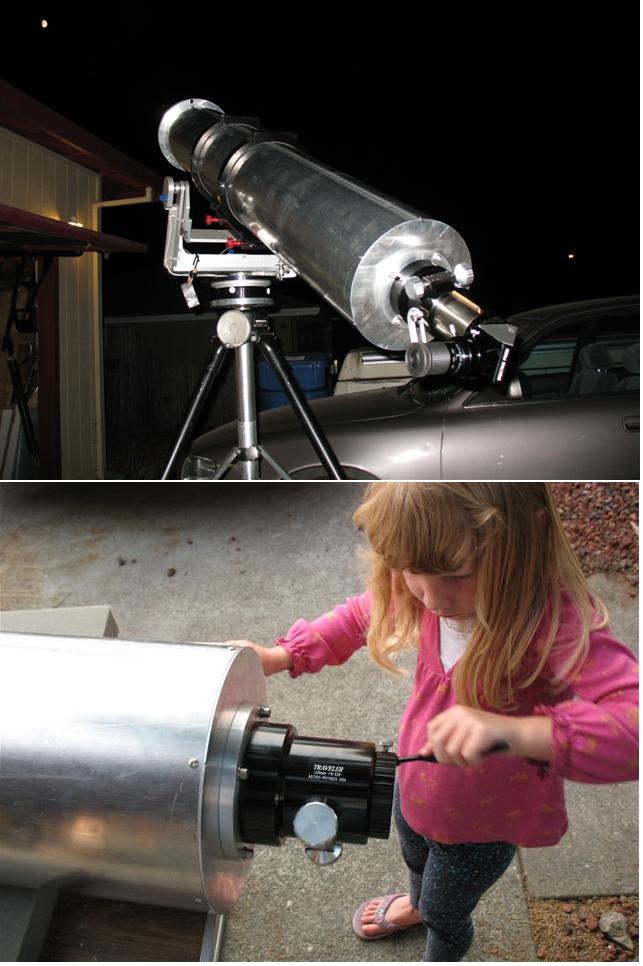
I am getting close to finishing my 8" f10 achromat OTA (Ukraine Lense) with first light this last weekend. Lots more to do, baffling. flocking, choosing paint color etc. I designed the lense mounting cell to be removable from the OTA end plate flange. I have captive thumbscrews on the tube flange, and guide pins on the lense cell so re-mounting is repeatable. For transport the lense and focuser are removed, with the empty tube length less than 5.5ft long, and ~20 lbs, fairly easy to manage. However fully assembled the tube is at 6 feet, and shy of 50 lbs which makes for somewhat of a beast. (note: Blonde assistant also wanted to help clean the lense)

As you know, the needle sharp pinpoint stars are breathtaking.

Finally saw the three larger craterlets in Plato without much trying.

Jupiter was still boiling being low on the horizon, but the mottled subtle detail on the polar regions was very satisfying. (Pentax SMC 9mm)

I also have a short tube 8" f6 doublet which gives beautiful wide field views. The Veil, Double Cluster, dark nebula, Milky Way, Virgo Galaxy clusters, and of course Sagittarius region all are awesome targets.

I liked the 8" so much, I am in the process of having an 11" f8 refractor lense quoted. (remove common sense here) I can send you some details if you want. They want a hefty tooling charge, but if they make more than one lense, it would be much cheaper.(hint hint). I would also plan to have this a portable instrument.

Also I know someone who has a 10" f9 fluorite triplet lense if your need is serious ; )

PS. In your link, it was interesting to see how they placed the pack of cigarettes onto the lense for scale - yipes !! Any idea how much the lense finally sold for ?


Attached Image:

David Simons's attachment for post 123599

David Simons
Posted 07/15/2008 11:52PM #6
Hi Larry,

For many years I observed the planets with Leiden Obervatory's 10.5" refractor, with object glass by Alvan Graham Clark (Ø = 26.6 cm, f = 392.6 cm) on a Repsold mounting (1885).
It was capable of beautiful views, especially of Jupiter and Mars. It needed exceptional seeing to unleash it's full potential. Only once, during the great 1988 Mars opposition did I experience such seeing. At 400-600x the image stood still, revealing structures on mars not found on any map, just on the NASA/S&T Mars globe. Round, craterlike details were seen.
Interestingly, it has a Zeiss 130mm (5.1") f/18 semi apo of the early 20th century installed as a finder/guidescope. On most normal nights, that scope gave a cleaner, purer, sharper image than the 10.5". But boy, under the right conditions, the 10.5" just leaves you with images right out of the window of a spaceship.

Erik