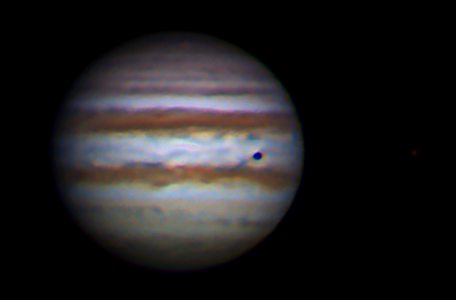
Image of the day

Captured by
John Roach

Jupiter IO Transit 12-10-26

My Account

New to Astromart?

Register an account...

Need Help?

Color corection vs. operating temperature

Started by kingfish, 12/18/2007 06:58PM
Posted 12/18/2007 06:58PM Opening Post
In the case of a well designed and manufactured apo triplet, is there any significant changes in color correction if the scope is being used say at ambient 100 deg. F as opposed to 0 deg. F assuming the scope it throughly temperature stabilized? Do all the elements equally expand or contract along with the lens cell to keep everything in balance and harmony or is there a specific temperature that the correction is optimized for and a correction curve is generated for + or - that temperature? If it does shift, in which direction of the spectrum does it shift for higher or lower temperatures?

DanL
Posted 12/18/2007 07:14PM #1
Hi Dan

if the scope in mind is cooled down it shows always the same colorcorrection, no matter which temperature it was stabilized

regards
Markus

clear skies

Markus Ludes
APM-Telescopes/Germany
Posted 12/18/2007 09:05PM #2
Interesting question. I ran a couple models based on
Ceragoli's description of the AP160, and there were in
fact minimal changes in the spherical and color
correction. Only thing that changed much was the
focus by about 1.6mm from 0 degC to 30 degC. (And
that includes only the lens, not the cell, OTA tube,
etc.) Probably other popular triplet APOs will be
similar.

The thermal expansion should not be a problem if the cell
is well designed. Most normal lens glasses have TEC around
6-8 (units of 10^-6). Fluorocrowns (FPL-51/52/53/OK-4)
are 12-14, Fluorite is around 19. Aluminum alloys are
12-14, steel alloys are 6-8. I can see where aluminum
cells might get too tight on "normal" glasses at low
temps, or steel cells too tight on the Fluorocrowns at
high temps. But in a well-made cell there should
be allowance for expansion / contraction. It would
seem to need both good design and accurate machining.

I note that LZOS uses steel cells for the larger lenses,
and this makes sense -- the TEC is lower and there will
be less tendency to squeeze the glass at low temps.
http://www.lzos.ru/en/astro_apohr.htm

The only temperature issues I have personally ever seen
with triplets are two with aluminum cells that got too
tight or pinched at low temps (below 0 degC). This is
readily evident in a star test where huge deformations
appear around the spacers. But it was easily fixed
by machining the cell inner diameter a few thousandths
larger (and the scope maker was happy to do it!).

Expansion / contraction along the optical axis is usually
allowed for by spring-like pressure pads machined
into the cell. These will allow for thicknesses to
change, and yet keep everything "tight." But these will
fail if the diameter of the lens is tightly squeezed
by the cell.

Another set of issues occurs if different elements are
at different temperatures. This can happen if the
night time temperatures are falling, if dew heaters
are used, etc. I've not modeled that one, but from
experience it seems not to be a significant problem
with these triplets. (I have seen some issues here
in short-focus doublet achromats.)

Anyway, in general, it should not be a problem and is
nothing to worry about.
