Image of the day

Captured by
John Roach

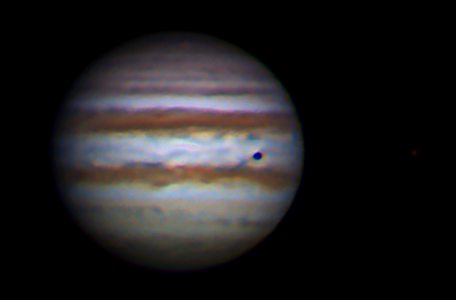
Jupiter IO Transit 12-10-26

My Account

New to Astromart?

Register an account...

Need Help?

Collimating a refractor?

Started by claytonjandl, 09/26/2003 07:24PM
Posted 09/26/2003 07:24PM Opening Post
I just got a new 152TAK, and was wondering is there an easy way to check if it is collimated properly? And if it is'nt how can I collimate it?

Nick T
Posted 09/26/2003 08:32PM #1
Thanks Mike I'll try it out, took it out only once, the day I got it (last mon.) and the seeing was awfull, so eveything seemed blury (we had a heat wave that day)but there were a couple of moments when things settled down and things looked ok, it looks like the scope has alot of potential.

Nick T.
Posted 09/26/2003 08:33PM #2
Nick,

You are indeed a lucky fellow if you have a Tak 152 to be concerned about. With the reputation of Takahashi, I seriously doubt your 152 would be out of collimation. I agree with Mike that the star test is a good indicator, but I would ad that I have been told that you also need to check to see if the diagonal affects the collimation. In other words, the scope with the diagonal should also check out on the star test.

Bob
Posted 09/26/2003 09:55PM #3
Hi Nick,

If you wish to collimate, Takahashi makes a collimation telescope that attaches to the scope. It has a port that can be illuminated to cast light onto the lens elements ( the lens cap must be in place to perform this operation). The scope will show two circles of reflected light, one for each element. It will actually focus on each ring separately by pulling the collimation scope draw tube. If the rings are concentric, you are home free. If not, you will have to adjust the lens with the three sets of push-pull collimation screws around the lens cell until they are. It is actually quite easy once you do it a time or two.

Art is the guy to talk to about obtaining the Tak collimation scope and a 1 1/4" adapter if needed. I have one and use it with all of my refractors just to make sure. The greatest advantage is that you can do it at your leisure day or night and do not have to worry about tracking or have an unsteady atmosphere to contend with!

Larry
Posted 09/26/2003 10:08PM #4
A Cheshire works very well. I set the scope out on a bright sunny day. Cover the lens and place the Cheshire directly in the focuser with the angled reflector aimed toward the bright blue sky. All the reflections you see when you look through the Cheshire should be concentric. Because most modern quality refractors are well corrected for coma and astigmatism over a fairly wide field, further tweeking in not needed.
Posted 09/26/2003 11:44PM #5
Hi,

I have found that if I put a laser used for collimating a reflector in the focuser I sometimes find that the focuser is not lined up exactly with the objective. Looking in the front of the scope the red beam should be in the center of the lens. I have then tweaked the focuser mounting to align to the center. You need to mahe sure the focuser does not have a loose fitting adapter in it and tighten down any friction adjustment on the focuser and rack it all the way in. Do not use a diagonal, but this is a good check afterward to see if your diagonal is a true 90 degrees.

After centering the beam on the objective I have actually found less flare on bright objects.

Don Durbin
