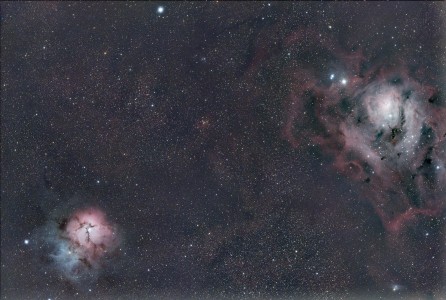

Finally we had clear, marine-layer-free skies until about 2am last night. I used the opportunity to christen my new Antares 105mm long focus achromat. The setup included the Antares refractor mounted on a Celestron AS-GT Equatorial head on a 48" Antares Pier. Also used were a Meade 2" Dielectric Diagonal (quite nice, actually) and the following eyepieces: 8mm Vixen LVW, 9mm University Ortho, 12.5mm University Ortho, 18mm University Ortho, 21mm Pentax XL and 40mm University MK-70.
Though the scope is supplied with a 2" compression ring extension tube, it was not needed to bring any of these eyepieces to focus, and actually prevented the 40mm University MK-70 from reaching focus when it was installed. I am not sure why the adapter was included.
Overall the AS-GT on the Antares Pier (using an Orion 13" SVP dovetail bar and the stock Antares tube rings) was adequate for visual use. Slewing, moderate breezes and focusing induced vibrations that took 3 or so seconds to dissipate. This is about the upward limit of my tolerance for vibration dampening. Next session (tonight hopefully) I will try some VSPs and perhaps switch to the tripod legs from the AS-GT plus an Orion 16" pier extension. Nonetheless, for visual use it was tolerable if not optimal.
Optically the Antares refractor was very, very good. Star testing on Arcturus revealed nice concentric rings virtually identical on each side of focus using the 12.5mm University Ortho (120x). Arcturus and Antares showed virtually no false color using any of the eyeieces listed. I did not use Vega as it was nearly directly overhead (and thus hard to view due to diagonal placement near the zenith) when I was checking for chromatism, but tonight I will use Vega and some very high magnifications to better describe the level of chromatic aberration visible at various magnifications on very bright objects.
The long focal length (1500mm) coupled with modest aperture (105mm) makes for some fairly narrow TFOVs and some dark backgrounds using eyepieces you wouldn't consider "high power" in a faster refractor. The nice aspect is that you can attain decently high magnifications without the extra elements of a Barlow and retain a goodly amount eye relief.
Other observing targets included some wonderful late-Summer globulars: M22, M10, M12, M13, M4, M80; the "Wild Duck" M11, "Ptolemy's Cluster" M7, and the "Butterfly" M6; planetary nebula M57; double stars Rasalgheti (Alpha Herculis), Albeireo and Epsilon Lyra (as the last object of the night) and a series of emission and reflection nebulae in Sagittarius, including M17, M8 and M20. The scope performed admirably on each, showing good resolution of globulars save for M80, which only hinted at resolution, hints of the darkest gulf/channel in M20, significant detail in M17, the nebulosity in M8 directly observable. The double stars were easy prey. The Double-double, in particular, was ultra-cleanly resolved at 120x and relatively easy to separate at 75x.
One curious thing I will mention regarding M57 which has been bugging me for years is the following. When I think back to my first observations of M57 25 years ago with a 6" f/8 Newtonian, I vividly recall the object looking like a faint smoke ring with a distinctly darker center "hole". As time has marched on, now no matter what aperture I use on M57, I see more nebular material in the area of the "hole". The edges certainly are brighter and "ring-like", but the middle is not as dark as it used to be. It doesn't seem to matter which aperture I use either. The center "filling" is there at 3" and at 12". I am guessing that maybe my eyes have changed? Dunno.
All in all, the scope performs about as well as a 4" can perform, and at $650 shipping included it is a relative bargain to boot. Over the next couple of weeks I will be assessing just how much of a "bargain" it is in same-night side-by-side comparisons with an Orion 100ED. The moon should become more usable as a fine detail target during this period. Unfortunately Jupiter is too low for use as a testing target.
More later.
Cheers,
Jim
