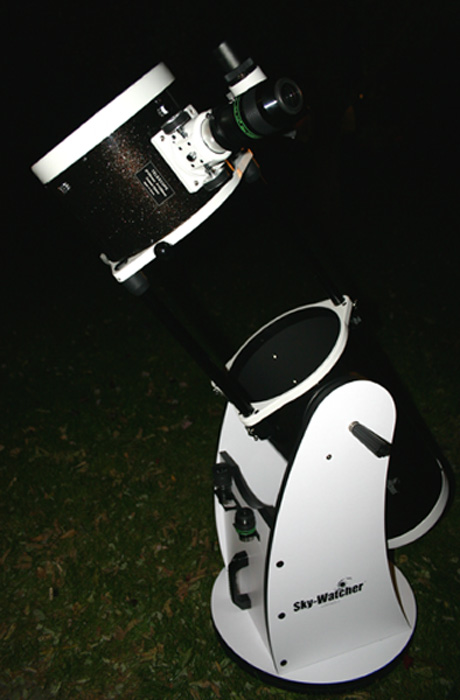
I recently used a 12" Meade Lightbridge. Here is some review I started to write. Overall I would probably buy it again. It seemed pretty good for the $$ paid. I have not tried any of the other ones you mentioned:
This is a brief review of a new Meade 12" Light Bridge scope after five nights of observing. The scope was ordered from OPTcorp.com and directly shipped UPS ground to a remote observing site in AZ, where it was assembled and tested for five nights. It arrived on time with no drama. Packaging was excellent. There was no shipping damage at all.
Assembly of the telescope progressed smoothly. The instructions were generally adequate, though having some knowledge of Dobs definitely helped -- I can see where the complete newbie might have gotten stuck at a few points. All parts were present; nothing was missing.
Mechanical Quality: The fit and finish of the parts was generally excellent. At almost no points were any mods / filing / sanding / shimming needed to make parts fits. The trusses fit snuggly into the lower OTA tube, and held the upper tube very solidly -- the design was very nice.
Optical Collimation: We used a laser to set the initial collimation, and later touched-up the collimation on a bright star at high power. This all proceeded smoothly. The scope appeared to hold collimation well through-out the night, but did need some re-collimation after disassembly of the OTA truss and transportation.
General Handling: The scope was generally easy for one person to move. The assembled OTA could easily be lifted out of the Dob base and carry some distance and set down. The rear of the OTA had three nice thick rubber feet to set it on. A second trip was then required to move the base, which was also easily handled. If two people were available, it was fairly easy to lift the entire scope + base assembly at the base and carry it to a new location.
A few handling issues did appear early-on: One issue quickly surfaced regarding placement of the fan power connector. When the battery pack is plugged into the socket, moving the scope towards the zenith will cause the plug to hit the azimuth tension knob on the scope base, causing the fan connector to break into pieces. We eventually disassembled the rear cell and repaired the connector, and put a large warning flag on the battery pack to disconnect it before moving the scope. I note that some early reviews of the scope said the connector was too close to the collimation screws -- apparently they have move the connector, but made a new problem also.
Also the red dot finder wobbled considerably in its base on the scope. We fixed this by adding blue tape (so-called Painter's Tape) shims to the base on the scope to tighten-up the fit.
Optical Quality: Testing the system on bright stars overhead with a 5mm eyepiece showed it suffered from both mild astigmatism and spherical over-correction. It was approximately diffraction limited, but no better. Most of the errors were in the primary mirror. I was eventually able to remedy the astigmatism in the primary by heating the secondary to generate an equal but opposite error, as described further below. On the positive side, the optical train was well laid-out. The secondary was properly sized. Collimation adjustments worked well, and collimation was easy to perform. The optical path was generally clean with few un-needed obstructions. Overall I would say the optical performance was better than expected, considering the mass-produced nature of these scopes and inexpensive price.
Modifications: A number of modifications were made within the first few days of using the scope:
We installed Bob's knobs on the secondary mirror. I could see that eventually the Phillip's screwdriver would get dropped onto the primary while trying to collimate in the dark. The Bob's Knobs work really well on the secondary.
The stock configuration for the primary mirror collimation had nice fluted knobs on the primary cell -- black ones for adjustment and white ones for locking. However, when collimating in practice it was impossible to reach back there and tell if you were turning a white or black knob. So we also replaced the three lock screws on the primary cell with round ones from Bob's knobs (as opposed to the fluted stock ones). Now I could just reach back there and tell what was what without trying to kneel down and look with a flashlight -- much easier.
I note that the Bob's Knobs primary adjustment knobs (as opposed to the locking screws) would not fit the scope. Apparently either Meade has changed the design, or there was some mix-up at Bob's Knobs.
Other modifications to the primary mirror cell: In my quest to study and cure the astigmatism, I had a hard look at the primary mirror cell design. I saw a couple potential issues. First we loosened by several turns the six screws (3 sets x 2 screws each) that held the mirror down. We moved the rubber pads so they were well above the mirror, and not touching it at all.
Next we noted that the mirror was "glued" to the nine-point floatation cell with double-sided tape. I am not sure this was itself a problem, but it made it impossible to rotate the primary mirror to study the astigmatism. So I replaced these with round cork pads from the hardware store. This also made the triangles of the floatation cell free to rotate, which was not good, so I tied the triangles to each other with some fishing line -- this prevented them from rotating. I note that the floatation triangles are not optimally designed - they were equalateral triangles but should have been more like flattened isocsiles triangles, but I did not attempt to correct this.
I could not see what supported the side of the mirror. After running a piece of paper around as a "feeler gauge" I decided the side of the mirror was resting on irregularities or flubs in the cell casting. I used a metal file to remove and smooth these out. I also added two pads made of 6 layers of 1" x 1" blue tape (painter's tape) near the 5 and 7 o'clock positions along the inner wall of the cell. These gave the mirror something soft to rest on and provided more uniform support.
Eventually I determined that the astigmatism rotated with the primary mirror, and hence was ground into the glass, and no amount of re working the cell was going to fix it. The fix instead, was to warp the secondary mirror by slightly heating it on the back side. Then by rotating the primary to align its warp with that imposed on the secondary, the net astigmatism would vanish. Heating the secondary was necessary anyway, as it tended to frost-up pretty quickly on humid nights. Heating was accomplished by simply wrapping a 1" diameter Kendrick heater strap on the narrow plastic body of the secondary assembly, and then laying over this several layers of thin foam packing material as insulation to drive the heat inward, and finally some flock paper to blacken everything. While a somewhat convoluted solution, it did fix the astigmatism.
In passing, I note the mirror itself was a rather odd size -- 303mm diameter -- which would make it difficult to replace with any sort of "drop in" premium replacement.
It was also impossible to prefectly align the optics in its stock configuration. This was traced to a slight tilt of the focuser, and adding a 0.03" shim on the top side of the focuser based (between the base and the upper tube) corrected this.
We wanted to use some large eyepieces with it, so we also added 3 pounds of ScopeStuff magnetic weights to the rear portion of the outer tube wall. These worked out quite well.
We also ordered the AstroZap light shroud. This generally fitted and worked well. It did have a tendency to droop into the light path (inspite of the sewn-in ABS rings), but this was easily fixed with a clothespin and a 12" long rubber band, which was used to pull rear-ward on the top rear of the shroud. The clothespin attached to the shroud, and the rubber band went over one of the rubber feet on the rear of the OTA.
There are several mods I have seen mentioned in other reviews which did not seem necessary, at least not yet. The truss poles were bright aluminum, but looking into the focuser, it was difficult to see any stray light arising from these. Also there did not seem to be any significant stray light coming from above the upper tube opposite the focuser. Both looking into the focuser or into eyepieces during daytime did not reveal any light paths in this area. Some people have mentioned installing a baffle opposite the focuser, but this did not seem necessary. Though we were observing at a very remote and dark site; perhaps if we had street lights in the area we might have come to a different conclusion.
Impressions after 5 nights:
The scope is generally excellent for low- to medium-power viewing. Views with a Nagler 31 T5 stacked with a Lumicon Coma Corrector were truly excellent -- pin point stars from edge to edge -- and no noticable light fall off. Most large nebulae and M objects were quite spectactular -- North America, Viel, M31, M33, M42, etc. Seeing was never really good enough for tests at high-power, though views of Jupiter were generally similar or slightly better than a nearby Meade 14" ACF scope.
Motions were generally quite smooth. After night 3 it developed a rather loud squeak whenever it was moved in elevation, though we have not yet looked into this issue. The altitude friction adjustment was quite useful, and it easily held 1 to 2 pound eyepiece changes. With the add-on weights, it balanced well for a wide range of eyepieces.
The focuser was really excellent. After some adjustment on the tension screws, it worked equally well with a big load (Nagler 31mm T5 + coma corrector) or a light eyepiece.
My overall impression is rather positive. Overall a very enjoyable scope to use. Mechanics are good, optics are OK. I would say it seems to give about 70% of the performance of a premium Dob for about 30% of the price. It won't replace my StarMasters, but for an off-the-shelf scope at under $1K, one can hardly complain.