
After viewing explicitly with a 6” f8 scope for 2 years, I recently acquired an Orion XT10. As I have found out, careful collimation is much more important at f4.7 than at f8.0. The scope came with a Lasermate which helped in aiming the secondary, but was frustratingly “twitchy” when trying to adjust the primary. A bit of web surfing turned up the barlow-laser technique which works quite well, other than the need to run back and forth between the adjustment screws and viewing the target screen.
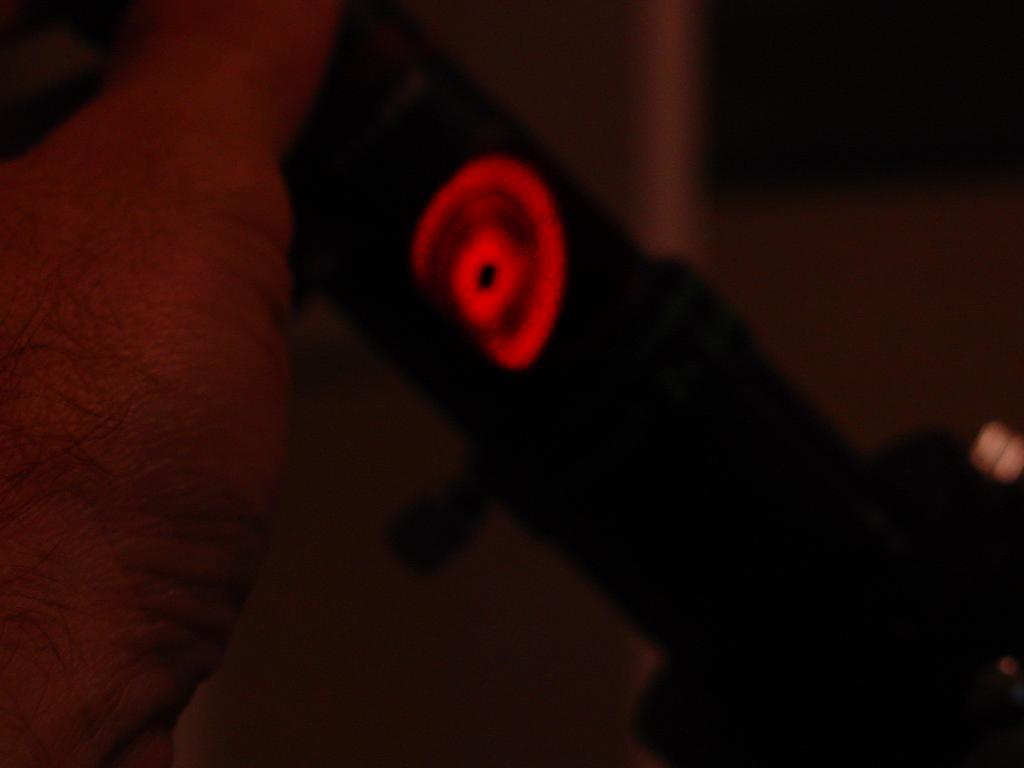
But, I recently noticed that the “donut” is also visible in the viewing window of the lasermate. It is enlarged, due to the barlow I assume. In fact, by chance, it neatly fills the 2nd of 3 rings in the viewing window(see attached image). Sure makes final tweaking a snap, and it doesn’t seem to be bothered by the less than snug fit of the lasermate.
OK, finally my question (hehe)
Is there anything technically wrong with this approach? A bit of web surfing did not turn up anybody else using this approach.
Thanks in advance for your comments.
Steve
Fort Worth, TX
But, I recently noticed that the “donut” is also visible in the viewing window of the lasermate. It is enlarged, due to the barlow I assume. In fact, by chance, it neatly fills the 2nd of 3 rings in the viewing window(see attached image). Sure makes final tweaking a snap, and it doesn’t seem to be bothered by the less than snug fit of the lasermate.
OK, finally my question (hehe)
Is there anything technically wrong with this approach? A bit of web surfing did not turn up anybody else using this approach.
Thanks in advance for your comments.
Steve
Fort Worth, TX
Attached Image:
