Image of the day

Captured by
Michael Scherman

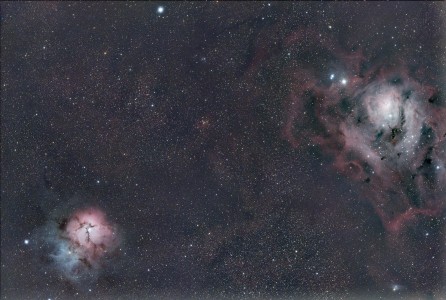
Lagoon and Triffid Celestron C6 Hyperstar4

My Account

New to Astromart?

Register an account...

Need Help?

The future- Single Pixel Multiplexing

Started by yahganlang, 10/03/2006 02:30AM
Posted 10/03/2006 02:30AM Opening Post
Only posting here because we were talking about similar things just a few days ago.

See ScienceDaily: http://www.sciencedaily.com/releases/2006/10/061002154230.htm

Someday entire telescopes may be made this way.

Jess Tauber
Posted 10/03/2006 03:06AM | Edited 10/03/2006 03:06AM #1
Very cool. Thanks for sharing. It all begins with just one new idea...then all of a sudden (metaphoically), everything has changed. This is indeed a very interesting technology with some wide ranging potentials smile
Posted 10/03/2006 03:33PM #2
Here's some real detail:

http://www.dsp.ece.rice.edu/cs/cscam-SPIEJan06.pdf

The impressive thing here is that instead of capturing all of the pixels and then compressing them to a much smaller dataset, they've found a way to capture much less information and still have an equivalent-quality final image.
Posted 10/04/2006 10:22PM | Edited 10/04/2006 10:22PM #3
Unfortunately, for astronomy it has a fatal flaw.

Rolando
Posted 10/05/2006 10:41PM #4
I'm really surprised that this discussion is focused on sensitivity. Roland is certainly correct that modern sensors can detect most every photon that arrives (leaving little room for improvement) and that the system described, with its single, small, photodetector, deliberately discards most (99.9+%) of the photons.

So, of course, it's not applicable to astrophotography, where you are trying (and need) to collect every photon from the FOV that arrives any time in a period of minutes or even hours.

Read their paper:

http://www.dsp.ece.rice.edu/cs/cscam-SPIEJan06.pdf

It's all about how, if all we want is a compressed image, we don't really need to initially acquire a full-detail original image. It's really an application some complex math, not a realistic imaging system.

Still, it might be valuable for systems in which detectors are difficult to fabricate. Perhaps millimeter waves or some other exotic radiation.

Alternatively, with extraordinary optics (holographic?) and a multi-pixel detector, you might be able to take all of the measurements at once, achieving the goal of using a smaller detector to get an acceptable image quality. It might make cell-phone cameras even smaller, lighter, and less expensive.

Jim, I think you have some valid questions. The mirror state is clearly necessary to reconstruct the image and so must be recorded (or computable) on a per-measurement basis. As the mirrors can be driven with a known pseudo-random (calculable) sequence, this isn't too hard. Also, I'm sure the math requires that the image not be time-varying: the noise of a faint astronomical signal would cause noise and/or artifacts in the reconstructed image.

Allen
