
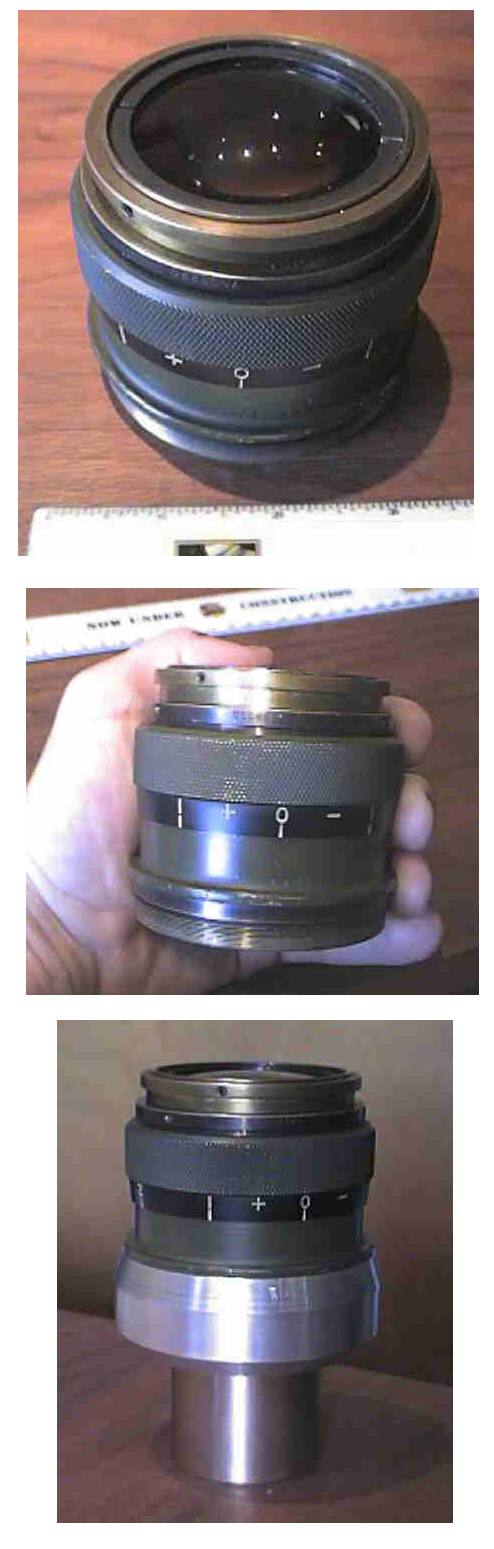
As part of another thread, the topic of radioactive war surplus optics, in particular eyepieces, came up. When I first heard this, I thought yeah, right, another urban legend. But I happened to have a huge old Erfle that apparently came off an M4 Sherman tank, and had just spent a lot of time making a wunnerful adapter to put it in 2" eyepiece tubes, when I heard that. So I had it checked out by a local hospital radiology department (after trying two fire stations and learning that one didn't have a clue and the other had thrown away its Geiger counters -- so much for the "security theater" of emergency preparedness, foreign nasties with dirty b--bs, etc). Sure enough, it was "hot" enough that one wouldn't want to put an eyeball behind it for any length of time. Like, when spending hours staring at deep sky objects. Now, just because it puts out alpha particles doesn't mean it's completly off limits. Alpha is easy enough to stop; a simple glass cover window would do it. But in this case, I gave up when I realized that the glass itself had turned brown from radiation damage, and my original idea of recementing the elements wouldn't fix that. A pity, because it's a wonderful hunk of glass and brass. For reference, I've again attached my image of this huge thing, with and without the aluminum adapter I made.
Here's a copy of part of a reply posted to a different thread here (under "help identify mystery eyepiece"). I figured this is a different topic and probably important enough to warrant its own thread.
========
In the process of researching this, I found some links on the web that might interest you. Radioactive glass isn't limited to old military stuff. All this is from those happy days of yesteryear when we were watching newsreels titled "Our Friend the Atom" etc. :-)
http://www.orau.org/ptp/collection/consumer%20products/cameralens.htm
http://www.angelfire.com/electronic/cwillis/rad/thglass.html
http://medfmt.8k.com/mf/radioactive.html
http://hps.org/publicinformation/ate/q1356.html
http://www.universetoday.com/forum/index.php?act=ST&f=14&t=4986&hl=&
http://www.mod.uk/linked_files/dsef/hp/jsp392/pdf/chap47.pdf
In particular, that last one says
Thoriated Lenses
4723. There are currently two types of thoriated lens in use. These are the thorium fluoride
coated germanium lens and the homogeneous thorium oxide lens. The coated lens can present an
internal hazard if the coating is damaged leading to the possibility of ingestion of thorium. The hazard from the homogeneous lens is principally an external radiation dose to the eye.
4724. Equipments containing thorium lenses are also to be marked with a radiation warning
sign unless this is not possible for operational or other safety reasons.
4725. In applications where thoriated lenses are placed close to the eye, they are to be replaced with a non-thoriated substitute where operationally acceptable or where modification of the equipment is undertaken, a plain glass shield is to be introduced between the lens and the eye.
Here's a copy of part of a reply posted to a different thread here (under "help identify mystery eyepiece"). I figured this is a different topic and probably important enough to warrant its own thread.
========
In the process of researching this, I found some links on the web that might interest you. Radioactive glass isn't limited to old military stuff. All this is from those happy days of yesteryear when we were watching newsreels titled "Our Friend the Atom" etc. :-)
http://www.orau.org/ptp/collection/consumer%20products/cameralens.htm
http://www.angelfire.com/electronic/cwillis/rad/thglass.html
http://medfmt.8k.com/mf/radioactive.html
http://hps.org/publicinformation/ate/q1356.html
http://www.universetoday.com/forum/index.php?act=ST&f=14&t=4986&hl=&
http://www.mod.uk/linked_files/dsef/hp/jsp392/pdf/chap47.pdf
In particular, that last one says
Thoriated Lenses
4723. There are currently two types of thoriated lens in use. These are the thorium fluoride
coated germanium lens and the homogeneous thorium oxide lens. The coated lens can present an
internal hazard if the coating is damaged leading to the possibility of ingestion of thorium. The hazard from the homogeneous lens is principally an external radiation dose to the eye.
4724. Equipments containing thorium lenses are also to be marked with a radiation warning
sign unless this is not possible for operational or other safety reasons.
4725. In applications where thoriated lenses are placed close to the eye, they are to be replaced with a non-thoriated substitute where operationally acceptable or where modification of the equipment is undertaken, a plain glass shield is to be introduced between the lens and the eye.
Attached Image:
