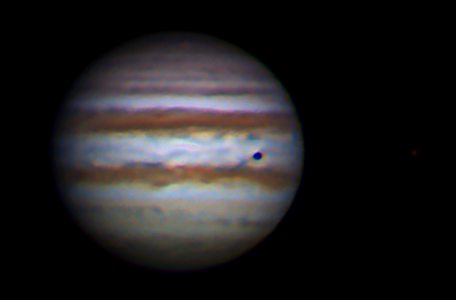
Image of the day

Captured by
John Roach

Jupiter IO Transit 12-10-26

My Account

New to Astromart?

Register an account...

Need Help?

Upgraded 125ETX or Small TV refractor?

Started by pgruener, 11/22/2002 05:18AM
Posted 11/22/2002 05:18AM Opening Post
Hi,
I have been involved with astronomy for a number of years and I am looking for a nice mid-sized scope, something in 5" range for occasional visual observations or a smaller refractor. From my somewhat light polluted skies I like to look at the moon, planets, double stars, clusters and what deep space objects I can muster. I have owned and enjoyed several Maksutovs up to 7" inches. I will not be able to afford another good 4" APO for a while so I have been thinking about the new improved Meade 125 ETX with the metal reinforced mount or a used 70-85mm refractor such as a Televue.

The questions:

When one factors in the central obstruction, will a smaller refractor show as much nebulosity and brightness in say M42 as the obstructed ETX125 or will the bigger mirror of the ETX still pull in more light?
With the addition of the metal reinforcement to the ETX125, is the mount now stable? I know it will not be like using my old GM8, but is the mount OK now for visual use up to say 200x?
Will a TV Pronto hold up to magnifications of 175x for planetary observations, or do you need to move up to the 76 or 85 APO TV scopes?

I am interested in first hand observations and experiences. I have read the reviews on Cloudy Nights and Scope Reviews. Thanks much in advance. Paul G.

Posted 11/22/2002 01:38PM #1
Paul,
Just to respond to you regarding the Pronto holding up to 175x. That's a "yes". I've had my Pronto for only a few months now, but have had no breakdown of image at powers higher than that. Weight and size are wonderful for a grab and go arrangement. No knowledge of the ETX125.
Good luck,
-Curtis
--
--
--
Posted 11/22/2002 08:16PM #2
Paul:
I have an EARLY ETX125 with plastic mount and horrendous backlash in the drive train. However optically it is top notch. It easily handles 200X, I've used over twice that for double stars. With good conditions, up to 380X is useable on the planets (5mm TAK LE) with little image degradation...though typically I stay below 300X.

I also have a TV102. Side-by-side on DSO's I much prefer the ETX. It begins to show some detail on faint fuzzies and globulars while the Televue simply shows that they are there. For example, the ETX begins to resolve M13 with an image that looks like a scattering of diamonds lying on a swatch of white silk. The TV102 just shows the 'white silk'. I actually bought the TV102 to replace the ETX; but, after comparing the two, kept the ETX.

The refractor is a little better on double stars, yielding a cleaner image that allows easier detection of faint, close companions; but once I return to the ETX I can see the companion in it too...it's just not as apparent. Of course for wide-field views, there's no contest...the Televue wins every time. The long ETX focal length simply will not permit the wide True FOV the short f.l. refractor provides.

Two things made the ETX 'work' for me:
1)forget about Autostar; it's more hassle than it's worth. Goto accuracy never amounted to much anyway. Use the simple hand control paddle that comes with the scope instead and starhop to your targets with the help of a 1X red-dot finder.
2)Take the money you saved on Autostar, add it to the $ you were going to spend on the #884 'deluxe field tripod' and get the #887 'advanced field tripod' instead. The #887 tripod comes with a very sturdy wedge. Both tripod and wedge were originally designed for an 8" SCT. Even my early ETX is pretty solid when mounted on the #887. I keep mine set up on the wedge and simply carry the complete unit outside when I want to observe.

The hand paddle lets me activate the RA drive at sidereal rate so, with a rough polar alignment, tracking is good to go for visual use. Of course you can mount the ETX Alt-AZ on the #887 tripod for even more rigidity, but then you won't have tracking.

Even with its faults, my ETX sees much more use than my GM8 mounted Televue. Besides being more convenient, there's no question, in my mind, that the ETX shows me more. I've never looked through a Pronto, but with the difference in aperture, I'd be very surprised if the ETX didn't blow it away.

Hope this helps.
Bob Young
Posted 11/23/2002 11:04AM #3
I have owned a 5 inch SCT, a 6 inch Mak, A 6 inch Mak Newt, a TV Ranger, and a TV-85. What follows is what I have learned so far.

The Ranger(Pronto) is usable up to about 160. Although image is not degraded the view starts to get uncomfortably dim at higher mag. The scope is very light and is a pleasure to use for quick peeks outside and it makes an excellent solar scope. The TV-85 compares favorably with a five inch SCT and you would not miss the 5 at all if you owned this scope. That said, the SCT costs 1/4 of the price and the only bad thing is the smaller field of view and longer cooldown time.

The six inch Maks with small central obstruction and quality optics are noticably better than the TV-85 both planetary and deep sky, especially the Mak Newts but that is going off topic (not as portable and requires hefty mount). The performance of the TV-85 is fantastic for its aperture though and it still does a decent job against the 6 incher. The cooldown time and price of the ETX is about same as that of the intes MK-67 so I would opt for the six incher here.

If you want something for quicklooks then a refractor is the one to choose as they are ready to go in about ten minutes. If you want a scope that is light and that will make you forget about the bigger scopes you have inside and the price does not scare you - get a TV-APO. A small refractor will be the telescope you use more often regardless of what else you own. I now own a TV-Ranger which keeps me observing till my Mak is ready.


Emmanuel
Posted 11/23/2002 12:57PM #4
Paul,

I own a SV AT1010 on a Telepod and my friend owns a Pronto on a Panoramic mount. Athough 175x is probably the maximun on both, it doesn't give you a lot of steady seeing time at the eyepiece on an alt-az mount even with widefield EPs. I usually view between 90x-120x. For DSOs low power widefield viewing is a step up from binoculars, but then again, 80mm aperture is only 80mm of aperture. If you want to do some higher power lunar and planetary observation I would suggest at least a used TV 85, but a used TV Genesis or Vixen/Orion 102 ED is going for less... but for a few dollars more a Tak or TV 102 can be had... but the issue of sturdier mounts come into play. (The best laid plans usually go awry) I have a TMB 100/800 on a GM-8/Giro set up and the views are superior, but many times I go with the SV AT1010 because it is less hassle to set up in the back yard.

Good Luck, Owen