I'm a newbie at all this so excuse my questions if they sound really dumb. But I could use some advice from all of you that have so much more knowledge and experience.
I just got an Orion 120mm Skyview Pro EQ refractor for backyard viewing, including 10mm and 25mm eyepieces. My viewing area does have some street light interference, but taller trees shade most of it. I'm not sure exactly what I should be seeing with this scope and what exactly to expect from it and the eyepieces, plus what I should be purchasing as optional equipment that would enhance my viewing.
The moon has looked great with this scope and EPs. Mars (as of about midnight on Aug. 14 in Pennsylvania) seems to be a dot in the eyepiece, about the size of a pinhead (like the kind of pins with the colored plastic heads). Some of the brighter stars in the sky look more in focus, but are still just bright lights in the EP and really don't look much bigger than viewing without a scope. I haven't found any other planets or tried deep space viewing yet since it's been pretty overcast since I've got the scope.
As a lay person, what other eyepieces/barlows etc. should I get to compliment my viewing of the planets/moon/deep space objects?
My scope takes 1.25" and 2" EPs. What is the advantage to using 2" EPs over 1.25" EPs? Should I use 2" instead? (I wear glasses, but find viewing without them more comfortable).
Using the star diagonal "reverses" the image in centering in the eyepiece. Any way to correct this situation and have viewing of objects the same as my eye sees them, rather than reversed?
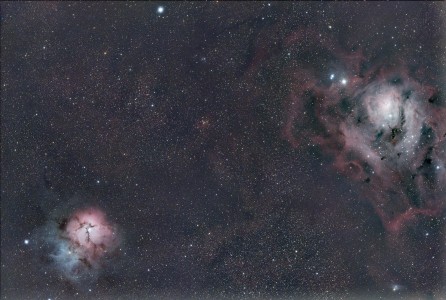
I see many photographs of great deep space objects but can't see these things with my eyes or telescope. Is that normal? Do these things become "visible" and "detailed" only when doing long exposures on film/photography? Or is there an eyepiece that would bring these objects into focus and visible through my scope?
I have the basic set of 4 colored filters. I really haven't noticed much benefit of using them, only to notice that the object being viewed gets "darker" and picks up the color of the filter (red, blue, green, yellow). When are these filters best used and on what?
Thanks for your help!
